No trading history doesn’t automatically rule out finance, but it changes what a lender can assess. If you’re exploring startup business loans with no trading history, you may be wondering whether a lender will consider your application without business revenue records.
Finance may be possible, but options can be limited for a business that hasn’t started earning revenue, and approval isn’t guaranteed. A lender may consider the purpose of the funds, your business plan, cash-flow forecasts and your personal financial position. Requirements differ between lenders, so an approach that suits one application may not suit another.
This guide explains the finance pathways you could compare, what information may help explain your business case and what to look at before applying. A lack of trading history is a hurdle to prepare for, not the only factor in an application.
Key Takeaways
- Startup business loans with no trading history may be possible, but an ABN alone doesn’t establish trading history or guarantee finance.
- Compare a business loan for broader needs with asset finance for an eligible purchase. The right structure depends on what you’re funding.
- Prepare a clear funding request, a business plan and cash-flow forecasts. Include relevant quotes for planned purchases.
- A finance broker can help explain lender requirements and compare potential pathways, but the lender makes the final decision.
Can you get startup business loans with no trading history?
It may be possible, but the lender’s decision depends on its policies, your circumstances and the information supporting your application. For startup business loans with no trading history, a lender may look beyond past sales to understand what the funds are for, how the business plans to operate and how repayments could be managed.
No trading history means there isn’t yet a documented record of business sales and operations for a lender to assess. It doesn’t automatically mean the application will be declined. A new business may simply not have had time to build revenue records. That’s different from evidence that the business cannot work, although a lender still needs to assess the risks involved.
What does no trading history mean to a lender?
A recently established business may have an ABN and a business plan but little or no operating history. A business with trading history can usually provide records of sales and activity over time. Without those records, a lender has less evidence of past business performance and may consider other information about the business, the funding purpose and the proposed repayment plan.
There’s no single approach across the market. Lenders can have different credit policies, documentation requirements and appetites. As a result, the absence of revenue records won’t lead to the same decision in every case.
Does a new ABN automatically rule out finance?
No. An ABN identifies a business, but it doesn’t show whether the business can meet repayments or guarantee finance. A lender may want to understand what the business will do and how the proposed funding supports it. For context, a startup company is generally a new business developing a product or service. A lender will still assess each application based on its own information.
If you’re considering a broader business loan, Speaking Finance can help you understand business loan options and how they differ from other finance structures. The relevant pathway depends on the funding purpose, your circumstances and lender criteria, not just the date the ABN was registered.
Which startup business loan options should you compare?
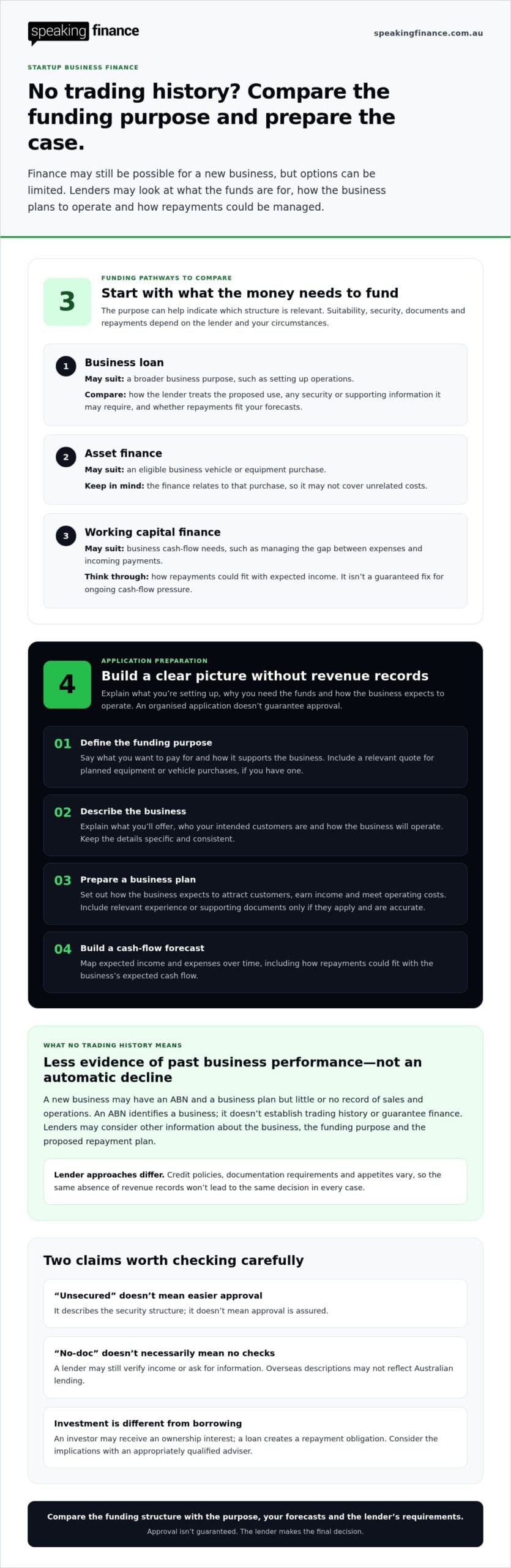
Start with what you need the funds for. A vehicle or equipment purchase may point towards asset finance, while a broader business need may call for a business loan or working capital finance. The structure, security requirements, repayments and documents depend on the lender and your circumstances, so compare how each option fits the purpose, not just its headline features.
- Business loan: This may be relevant for a broader business purpose, such as setting up operations. Find out how the lender treats the proposed use, what security or supporting information it may require, and whether the repayment structure fits your forecasts.
- Asset finance: This may be relevant when you’re funding an eligible business vehicle or piece of equipment. The finance relates to that purchase, so it may not cover unrelated costs. If you’re buying a vehicle, compare business vehicle finance options.
- Working capital finance: This may help meet business cash-flow needs, such as managing the gap between expenses and incoming payments. It isn’t a guaranteed fix for ongoing cash-flow pressure, so consider how repayments could fit with the business’s expected income.
When might asset finance or a business loan be relevant?
Match the funding structure to the purchase or cost. If you need a particular vehicle or piece of equipment, consider whether asset finance aligns with that purchase. If your costs span several business needs, a business loan may be a more relevant structure, subject to lender assessment. Being specific about the purpose makes the options easier to compare.
What trade-offs should founders weigh?
Compare any limits on how the funds can be used, possible security requirements, repayment arrangements and the information requested. “Unsecured” describes the security structure; it doesn’t mean approval is easier or assured. External investment is different from borrowing: an investor may receive an ownership interest, while a loan creates a repayment obligation. Consider the implications with an appropriately qualified adviser.
The phrase “no-doc business loans” can be misleading. It doesn’t necessarily mean a lender won’t verify income or ask for information, and overseas descriptions may not reflect Australian lending. Grants and government programs are separate pathways, often with specific criteria that can change. Check current details before relying on a program. To discuss a potential finance pathway in light of your business purpose, see how Speaking Finance can help.
How can you prepare a startup loan application without revenue records?
A clear, organised application can help explain the business when you don’t yet have sales records. It won’t guarantee eligibility or approval, and each lender may request different information. Use this checklist to show what you’re setting up, why you need the funds and how the business expects to operate.
- Define the funding purpose. State what you want to pay for and how it supports the business. For an equipment or vehicle purchase, include a relevant quote if you have one.
- Describe the business. Explain what you’ll offer, who your intended customers are and how the business will operate. Keep the description specific and consistent across your documents.
- Prepare a business plan. Set out how the business expects to attract customers, earn income and meet operating costs. Include relevant experience, existing contracts or other supporting documents only if they apply and are accurate.
- Build a cash-flow forecast. Map expected income and expenses over time, including how repayments could fit. Use assumptions you can explain and support, rather than optimistic figures chosen to make the numbers look better.
- Gather the information requested for the application. Depending on the application, this may include personal or business financial details and documents. Requirements vary, so check that figures are consistent and information is current and accurate.
What information can help explain a new business?
Connect the plan to the funding request. Explain what the funds will pay for and how that supports the way the business will operate. A forecast estimates future performance; it isn’t evidence of actual trading results or a lender’s commitment to approve finance. If you need help preparing or reviewing financial forecasts, speak with a qualified accountant.
How can you avoid preventable application friction?
Organise your documents before applying and check that names, figures and dates match across them. Avoid applying indiscriminately. Lenders’ enquiry and application processes vary, and a considered approach can help focus your preparation on pathways that may fit your circumstances.
How can a finance broker help compare startup business loan pathways?
A finance broker can help you understand and compare potentially suitable options, but the lender makes the decision. Speaking Finance is a finance brokerage, not a lender, so it can’t promise approval or determine how a lender will assess an application. For startup business loans with no trading history, a broker can help clarify what information different lenders may need and which pathways could fit your business purpose.
What should you expect from a plain-English finance conversation?
The conversation should start with your objectives and circumstances, not a one-size-fits-all product. A broker can then identify potential finance pathways and explain how lender policies, documentation requirements and appetites differ. That gives you a clearer view of what may be involved before deciding how to proceed. When choosing a broker, consider whether they explain the process and the options in a way you understand.
The brokerage process typically moves through these steps:
- Understand your purpose, circumstances and objectives.
- Identify potentially suitable finance pathways and lenders.
- Explain key requirements and differences in plain English.
- Collect and organise the information required for an application.
- Present the application to an appropriate lender or lenders.
- Manage communication, questions and document requests through the approval process.
- Assist through documentation and settlement, and provide post-settlement support where relevant.
What is a practical next step?
Be ready to outline where the business is up to, what you need funds for and what supporting information you already have. You don’t need every document in hand to start a useful conversation. Speaking Finance helps business clients understand finance options and lender requirements in plain English, while the lender remains responsible for its own assessment and decision.
Take a considered next step
Before deciding whether to apply, test the business case on paper. Is the funding tied to a clear business goal? Can you explain the assumptions behind your plan and forecast? This preparation can help you decide what to explore next, even while the business is building its record. It’s a practical starting point for considering startup business loans with no trading history, not a promise of finance.
Also consider how repayments could fit alongside expected costs and income. If important assumptions are still uncertain, refining them first may help you make a more informed decision about whether to proceed. The clearer you are about what you know, what you’re still working through and what the funds are meant to achieve, the easier it is to have a focused finance conversation.
Use that groundwork to decide on a next step that fits your business and circumstances.
Frequently Asked Questions
Can a startup get a business loan without trading history?
It may be possible to explore finance, but there’s no universal outcome. For example, a startup seeking funds to fit out a workspace will need to explain the costs and how the borrowing supports its plans. Lenders assess applications under their own policies and consider the applicant’s circumstances and supporting information. A broker can help compare potential pathways, but only the lender decides whether to approve an application.
Does having a new ABN count as trading history?
No. An ABN’s registration date doesn’t show whether the business has made sales or operated over time. If you’ve started trading recently, be clear about what activity has taken place and what’s still planned. Keep forecasts separate from completed sales or actual cash flow so your business stage is clear to a lender.
Do I need to provide a personal guarantee for startup business finance?
Possibly, but whether a guarantee is requested depends on the finance product, lender policy and your circumstances. Don’t assume it will or won’t be part of an offer. A personal guarantee may make you personally responsible for certain business borrowing obligations, so read any proposed documents carefully. If you’re unsure what a guarantee means for you, get independent legal advice before signing.
Will applying to several lenders at once improve my chances?
Not necessarily. Applying widely isn’t a reliable way to improve an outcome, and lenders may have different processes, information requests and ways of making enquiries. Before proceeding, understand what an application involves and what information may be requested. It can be more practical to organise your documents and consider which pathways fit your purpose than to send the same application everywhere.
Are government start-up finance programs available to every new business?
No. Government programs may be designed for a particular purpose or group, with their own eligibility rules and application steps. Those details can change, so check the relevant official government website for current information before making plans around a program. A targeted scheme shouldn’t be treated as a general loan option for every start-up, and eligibility depends on its current criteria.
To talk through your business purpose and potential finance pathways, see how Speaking Finance can help →

Article by
Steven Emms
Steven Emms is the Director of Speaking Finance, an Australian finance brokerage based in Melbourne, Victoria.
Steven and his team help consumers, sole traders and businesses navigate vehicle finance, equipment finance, business lending, working capital and personal finance. His approach is simple: explain finance in plain English, cut through unnecessary jargon and help clients make informed decisions.
At Speaking Finance, the philosophy is simple: **We make finance black and white.**
Outside of finance, Steven is a long-suffering Essendon supporter, which has given him plenty of practice managing expectations and dealing with disappointment.
Disclaimer
The information in this article is general in nature and is provided for educational purposes only. It does not take into account your personal circumstances, financial situation, needs or objectives and should not be relied upon as personalised financial or credit advice.
Speaking Finance is a finance brokerage, not a direct lender. Finance products, interest rates, fees, terms and eligibility criteria vary between lenders and are subject to individual assessment, applicable lending policies and approval. No finance approval or particular outcome is guaranteed.
Information is believed to be accurate at the time of publication but may change. Before making financial decisions, consider your circumstances and seek appropriate independent professional advice where necessary.