A business loan to pay tax debt can clear an overdue ATO balance in one payment, then let the business repay the lender over time. It may ease cash-flow pressure, but it also replaces tax debt with a new finance commitment. Eligible taxpayers can apply online for an ATO payment plan for debts under A$200,000, according to the Australian Taxation Office.
It’s understandable to look for a clear way through when a tax bill is putting pressure on day-to-day spending. But the loan’s repayments and total cost matter just as much as clearing the balance. The ATO’s general interest charge is 11.51% per year for October to December 2026 and compounds daily, according to the Australian Taxation Office.
This guide explains how a business loan to pay tax debt works, how to compare its costs with ATO charges, and how tax debt may affect your credit file and future business loan applications. You’ll learn what lenders may consider so you can weigh the options and plan your next steps.
Key Takeaways
- Compare the loan’s total repayments with the ATO debt’s ongoing charges, not just the headline interest rate.
- An ATO payment plan and a business loan work differently; understand how each affects cash flow and lender assessment.
- Unpaid tax debt can influence your credit file and future finance applications, so early action may matter.
- Loan structure, security and repayment terms vary between lenders, making it important to weigh options against your business’s circumstances.
Comparing loan costs with ATO interest and charges
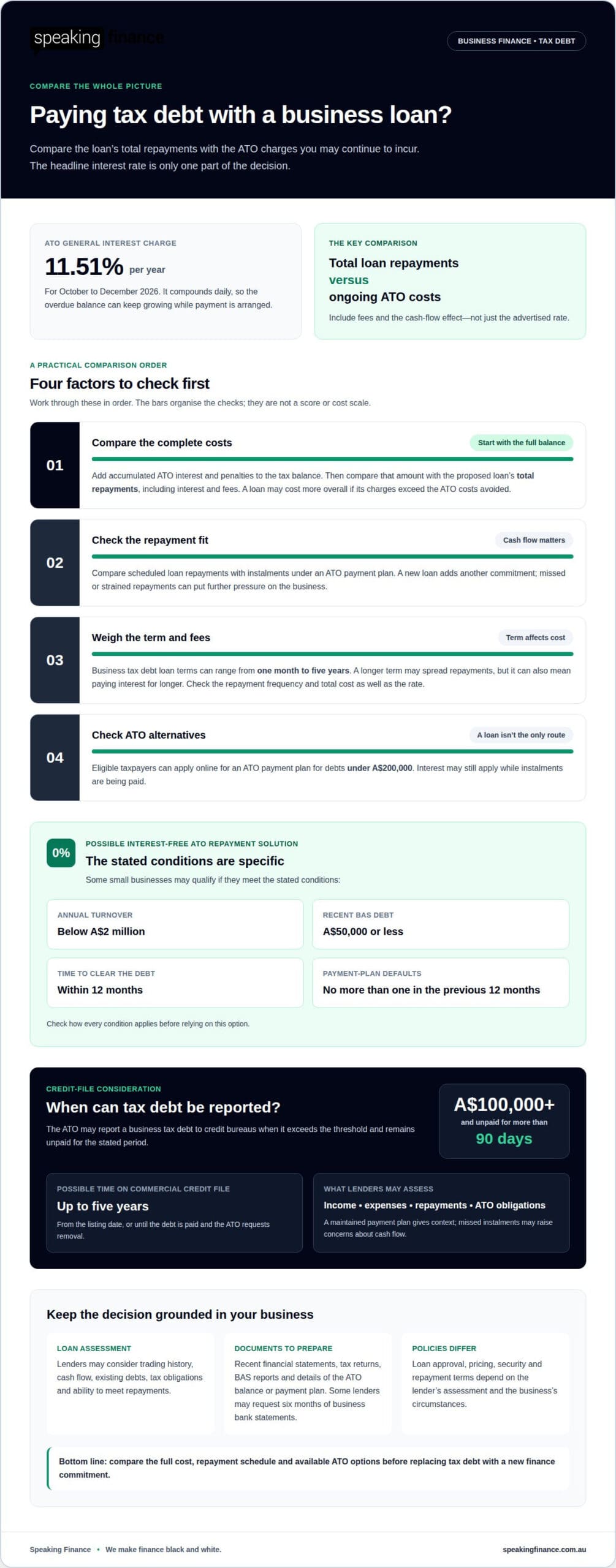
Compare the full cost of a business loan with the ATO interest that may keep accruing on overdue tax debt. The Australian Taxation Office sets the general interest charge at 11.51% per year for October to December 2026, with interest compounding daily. That charge can continue increasing the balance while you arrange payment.
Start with the complete tax balance, including accumulated interest and penalties, then compare it with the proposed loan’s total repayments. Look beyond the interest rate: fees, repayment frequency and loan term all affect the amount and cash flow impact. Business tax debt loan terms range from one month to five years, so a longer term may spread repayments but also extend the time you pay interest.
An ATO payment plan may let an eligible business clear debt in instalments, but interest may still apply while payments are being made. Compare the required repayments and ongoing charges with a loan’s scheduled repayments. A loan may simplify payment, but lender approval and pricing depend on the business’s circumstances and the lender’s assessment.
Some small businesses may qualify for an interest-free ATO repayment solution. The stated conditions include annual turnover below A$2 million, recent BAS debt of A$50,000 or less, the ability to clear the debt within 12 months, and no more than one payment-plan default in the previous 12 months. Check how each condition applies before relying on this option.
Can the ATO remit general interest charge or penalties? The ATO may reduce or waive penalties and some interest in cases of genuine hardship or extenuating circumstances. Treat any potential remission separately from the loan comparison, and include it only after the ATO has agreed to it.
What are the risks of using a business loan to pay tax debt? A loan adds a new repayment obligation and may cost more overall if its interest and fees exceed the ATO charges avoided. If repayments strain cash flow or are missed, the business may face further financial pressure. Compare the total cost and repayment schedule before deciding.
What is a tax debt loan?
A tax debt loan is business finance used to pay an outstanding ATO balance. Instead of repaying the tax debt in instalments to the ATO, the business repays the lender under the loan agreement. An ATO payment plan works differently: eligible taxpayers can apply online for a plan on debts under A$200,000.
What are the eligibility requirements for an Australian business loan to pay tax debt? Lender criteria differ, but a published minimum eligibility benchmark is six months of business operation. Lenders may also assess trading history, cash flow, existing debts, tax obligations and the business’s ability to meet the proposed repayments.
With an ATO payment plan, the business agrees to instalments over an agreed period. Keeping up with each payment shows the arrangement is being honoured; a missed instalment can leave the debt unresolved and affect how lenders view the business’s obligations. The ATO allows eligible taxpayers to apply online for a payment plan when the debt is under A$200,000.
For finance assessment, lenders may look at whether the ATO debt is covered by a current payment plan, whether payments are up to date, and how the new loan fits existing commitments. Some lenders review six months of business bank statements to understand income patterns and regular outgoings. A payment plan does not automatically rule out an application, but its repayment amount affects the business’s available cash flow.
What documents do lenders require for a business tax debt loan application? Prepare recent financial statements, tax returns and BAS reports. Lenders may also request six months of business bank statements and details of the ATO balance, payment plan and any missed instalments.
A lender’s assessment connects the tax position with the wider business finances. For example, steady deposits alongside manageable plan payments present a different cash-flow picture from irregular income and missed instalments. Explore finance options for your business if you’re weighing how a new repayment could fit.
How ATO debt affects business loan applications
Unpaid ATO debt can affect a business loan application through cash flow, credit reporting and the lender’s view of repayment risk. The ATO may report a business tax debt to credit bureaus when it exceeds A$100,000 and remains unpaid for more than 90 days. A listing can make it harder to borrow or obtain capital.
ATO-reported tax debt can stay on a commercial credit file for up to five years from the listing date, or until the debt is paid and the ATO requests removal. The ATO has had the power to report qualifying business tax debts since 2017. Early contact with the ATO and an active payment arrangement can help manage the debt before reporting becomes a concern.
Lenders assess the overall financial picture, not just the tax balance. They may consider business income, regular expenses, existing repayments and whether the business is meeting its ATO obligations. A payment plan being maintained gives a lender useful context; missed instalments may raise concerns about cash flow and the ability to take on another commitment.
Timing can also matter. If possible, establish a record of meeting ATO payment plan obligations for two to three months before applying. This gives the application evidence of recent payment behaviour. It does not erase the tax debt, but it helps show how the business is managing its commitments alongside normal operating costs.
Outstanding ATO debt can complicate later borrowing, while lenders are likely to view an existing business loan more favourably than unpaid tax debt. Many banks will not refinance tax debt, so lender policy matters. Any proposed loan guarantee also deserves careful attention because it can create personal exposure for the guarantor.
The practical takeaway: address the ATO debt early, keep agreed payments current and present a clear picture of business cash flow. Tax debts involving employee PAYG withholding or superannuation can carry added consequences, including potential personal liability for directors through Director Penalty Notices. Discuss these obligations with a suitably qualified professional.
What business loan options are available in Australia for paying tax debt?
Australian businesses may consider an unsecured business loan or a secured loan to pay an ATO balance. Unsecured finance doesn’t require collateral, while secured finance may use an asset such as property or equipment. The appropriate structure depends on the business’s finances, available security and the lender’s assessment.
Unsecured loan funds may be used to pay outstanding ATO tax liabilities, clearing the tax account in one payment and replacing it with scheduled lender repayments. Lenders set their own limits and assess each application under their credit policies.
A secured loan may be an option for a business with suitable assets that wants to borrow against them. Security can affect the lender’s assessment, but it also links an asset to the loan. Consider the consequences of missed repayments and weigh that risk against clearing the tax balance.
Some businesses may consider existing cash flow facilities, such as an overdraft or line of credit, where available and suitable. These can provide access to funds for business needs, but the limit, interest and repayment arrangements depend on the facility. Drawing on a revolving facility to pay tax debt still leaves the business responsible for repaying the amount used.
Compare options by reviewing the total repayable, fees, repayment frequency, security and effect on working cash. Include the full ATO balance, including accumulated interest and penalties, to understand how much borrowing may be needed. A loan can bring tax liabilities together, but it adds a separate commitment. Lenders have different requirements and appetites, so assess the structure against the business’s income and current obligations.
Speaking Finance
Speaking Finance can help you understand and compare potential finance options when an ATO balance is putting pressure on business cash flow. As a finance broker, it connects clients with more than 70 lenders, whose credit policies, documentation requirements and appetite for tax debt vary.
This comparison can help when weighing a loan against an ATO payment plan or when unpaid tax debt affects a new finance application. Speaking Finance offers tax debt finance and refinancing, and can help you understand lender requirements and possible structures in plain English. The lender assesses the application and makes the credit decision. Speaking Finance does not provide accounting or tax advice, so discuss your ATO obligations with your accountant.
If you’d like to discuss your situation and possible next steps, contact Speaking Finance.
Choose a next step that supports your business
Before taking on repayments, consider what the business needs to keep operating: a cash buffer, planned purchases or room for quieter trading periods. Looking beyond the tax balance can help you judge whether borrowing supports the business’s broader needs.
Work out what repayment amount the business could manage alongside those priorities, then discuss your tax position with your accountant or an established practice such as brownhamilton.com.au. If you’re still weighing the finance options, explore what may fit your circumstances before committing.
Frequently Asked Questions
Who offers tax debt loans for businesses?
A business loan may be used to meet tax liabilities, with finance brokers helping businesses explore lending pathways. Speaking Finance offers tax debt finance and refinancing, and can explain lender requirements and possible structures. The lender assesses the application and makes the credit decision. The tax liability, trading position, cash flow and available security can all shape which options may be worth considering.
Do I need a deposit for a business loan?
Some business loans require a deposit, while others may not. A deposit of 10-20% may apply in some cases, including when a business has traded for less than two years or seeks to borrow more than A$150,000 without owning property. Whether a deposit is requested depends on the lender’s policy, the application and the proposed loan structure.
How quickly can I receive funds for ATO tax debt?
Funding speed depends on the lender’s assessment and how quickly the application and supporting documents are complete. Non-bank lenders may offer same-day approval for online business loan applications under A$150,000, but approval is not the same as funds being available. Assessment, any follow-up requests and settlement steps can affect when the money reaches the business.
What happens if you don’t pay your business tax?
Unpaid business tax can have serious consequences, particularly for employee-related obligations. In insolvency, the ATO has priority over unsecured creditors for certain tax debts, including employee PAYG withholding and superannuation obligations. Lodge BAS and tax returns by their due dates even if the business cannot pay the full amount. Lodging keeps reporting obligations separate from the payment problem.
Can an Australian business loan be used to pay ATO tax debt?
Yes, a business loan may be used to pay ATO tax debt if the lender accepts that purpose. The application should identify the business as the borrower and explain the tax liability being addressed. This differs from a personal loan, which is assessed as personal borrowing and may not suit a debt owed by a business entity.
What interest rates, fees and repayment terms apply to business loans for ATO debt?
Interest rates, fees and repayment terms vary by lender, loan structure and business application. Before accepting an offer, review the repayment schedule and a clear breakdown of charges, including when fees apply. Check whether repayments are weekly, fortnightly or monthly, and how the schedule fits expected business income. This makes the cash commitment easier to assess.

Article by
Steven Emms
Steven Emms is the Director of Speaking Finance, an Australian finance brokerage based in Melbourne, Victoria.
Steven and his team help consumers, sole traders and businesses navigate vehicle finance, equipment finance, business lending, working capital and personal finance. His approach is simple: explain finance in plain English, cut through unnecessary jargon and help clients make informed decisions.
At Speaking Finance, the philosophy is simple: **We make finance black and white.**
Outside of finance, Steven is a long-suffering Essendon supporter, which has given him plenty of practice managing expectations and dealing with disappointment.
Disclaimer
The information in this article is general in nature and is provided for educational purposes only. It does not take into account your personal circumstances, financial situation, needs or objectives and should not be relied upon as personalised financial or credit advice.
Speaking Finance is a finance brokerage, not a direct lender. Finance products, interest rates, fees, terms and eligibility criteria vary between lenders and are subject to individual assessment, applicable lending policies and approval. No finance approval or particular outcome is guaranteed.
Information is believed to be accurate at the time of publication but may change. Before making financial decisions, consider your circumstances and seek appropriate independent professional advice where necessary.