If you’re self-employed and hold an ABN, some lenders may consider alternative income evidence for vehicle finance, subject to their requirements and assessment. Low doc does not mean no paperwork, no income verification or guaranteed approval.
An ABN alone won’t show a lender the full picture. Depending on the lender and your circumstances, it may also consider your business income, how long you’ve been operating, credit information and how you plan to use the vehicle.
This guide explains what low doc car finance can mean in practice, what information to organise and how to compare business and personal finance pathways. Alternative income evidence can change which documents are used, not remove the lender’s need to assess the application. Different lenders have different policies and documentation requirements, so start by getting clear on your circumstances and what you need the vehicle for.
Key Takeaways
- A low-doc car loan application may use alternative income evidence. An ABN alone does not establish eligibility or guarantee approval.
- Organise information about your income, business, credit history and the vehicle to get a clearer picture of your position.
- Compare documentation requirements, fees, repayment structure and any end-of-term obligations, not just the regular repayment.
- A broker can help organise an application and explore potentially suitable lender pathways. The lender makes the decision and sets the final terms.
What is a low doc car loan for an ABN holder?
Low-doc car finance describes an application pathway in which a lender may accept alternative evidence of income instead of its usual documentation. The evidence accepted depends on the product, the applicant and the vehicle’s intended use.
Low doc changes the evidence used to assess an application; it doesn’t remove the assessment or guarantee approval. The lender considers the application and makes its own credit decision. An ABN can help establish that you operate a business, but it isn’t an approval shortcut.
“Low doc” can sound like the paperwork has vanished. In practice, it refers to a potentially different evidence pathway. For background on the term, see this overview of a low documentation loan, but don’t assume every lender uses the same process or requirements.
Does having an ABN mean you qualify?
No. Your ABN is one part of the context, not a decision by itself. A lender may also consider your business circumstances, the information available to support your income, your credit information and the vehicle you want to finance. Intended use matters too: a vehicle for business activity may lead to a different finance pathway from one mainly for personal use. The lender assesses the application as a whole.
Is low doc the same as no doc?
No. Low doc may mean providing different evidence, not providing no information. Depending on the lender and your circumstances, that evidence could include business records or other information that helps explain income. You may also need to provide identity, business and vehicle details. There’s no universal low doc checklist, so don’t rely on claims that every ABN holder can apply with only an ABN.
If the vehicle is intended for business use, it may be worth exploring business vehicle finance alongside other car finance pathways. Speaking Finance can help you understand potentially suitable options, including how asset finance brokers for vehicle loans may help organise finance options. The lender, not the brokerage, decides whether to approve an application and sets the final terms.
What might a lender assess for a low doc ABN car loan?
For a low-doc application, a lender may consider the available income evidence, business activity, credit information and the vehicle’s intended use. Requirements depend on the lender, product and applicant.
Documentation requirements vary between lenders and applications. There isn’t one checklist for every ABN holder, so treat document examples as preparation ideas, not guaranteed requirements.
What information could be requested?
Depending on the lender, you may be asked for business or income information such as recent bank statements, Business Activity Statements (BAS), financial records or an accountant’s declaration. You could also be asked for personal details and information about the vehicle. These are examples, not a standard document list. The lender will outline what it needs for your application.
Before discussing an application, gather current information and check that figures and dates are consistent across your records. Speaking Finance can help organise requested documents and manage lender communication, while the lender makes the credit decision. For broader context, Canstar explains low-doc loan eligibility and criteria for home loans. Those specific criteria shouldn’t be assumed to apply to car finance.
Why can requirements differ between lenders?
Lenders have different credit policies, documentation requirements and appetites for particular applications. One may seek more detail about business income, while another may focus on different parts of the applicant’s or vehicle’s information. A document list from one lender won’t necessarily predict what another will request. Read about lender options for small business vehicle finance to understand why lender choice can matter.
Speaking Finance can help organise your information and consider potentially suitable pathways without assuming a particular lender will accept your circumstances. To talk through the options, see how we can help.
How to compare low doc car finance options as an ABN holder
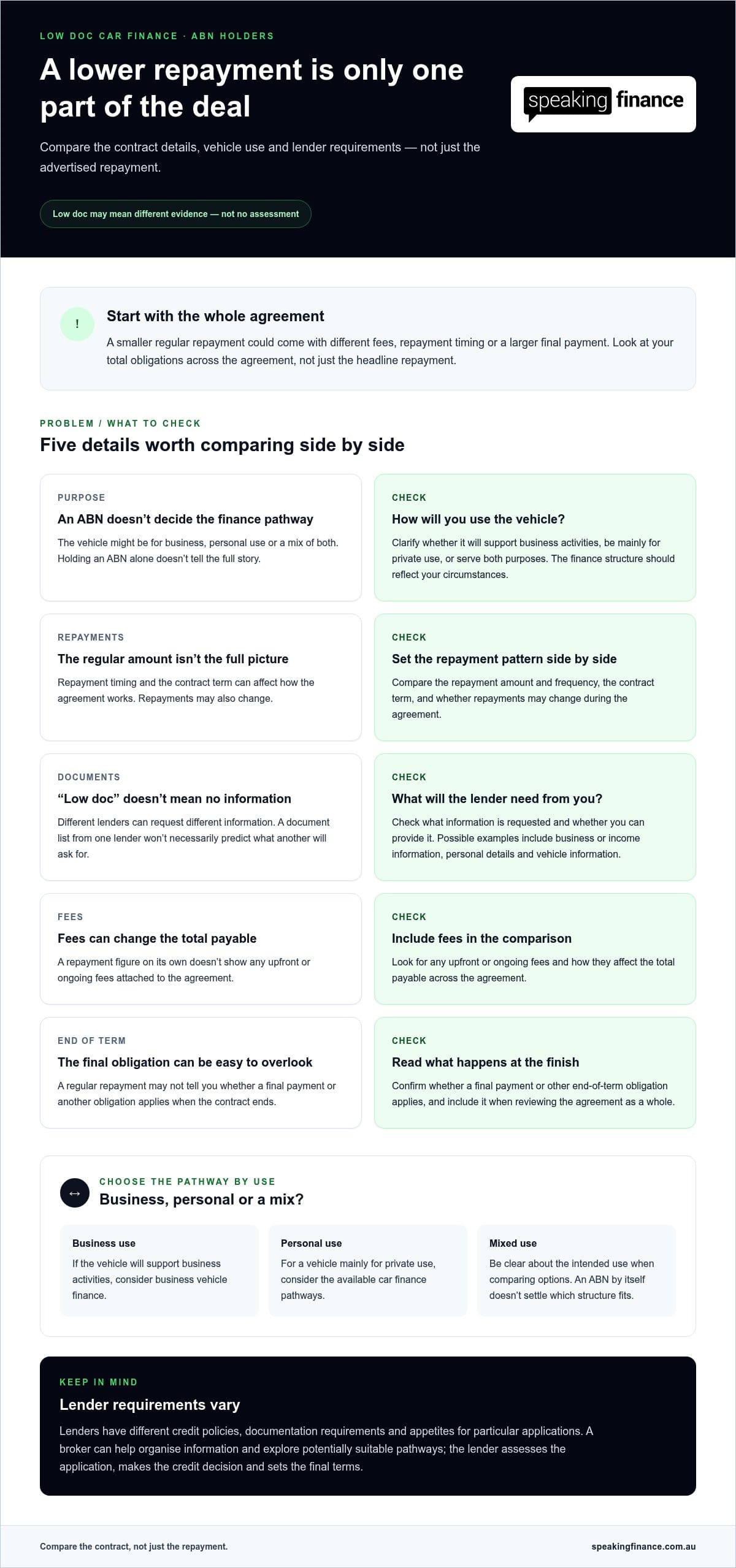
Compare the contract details, not just the advertised repayment. A smaller regular repayment could come with different fees, repayment timing or a larger final payment. Start by clarifying the vehicle’s intended use, then compare the finance pathways and terms that may fit your circumstances.
| What to compare | What to check |
|---|---|
| Purpose | Whether the vehicle is for business, personal use or a mix of both. |
| Repayment structure | Repayment amount and frequency, contract term, and whether repayments may change. |
| Documentation | What information the lender requests and whether you can provide it. |
| Fees | Any upfront or ongoing fees and how they affect the total payable. |
| End-of-term obligations | Whether a final payment or other obligation applies when the contract ends. |
Business or personal car finance: what should you consider?
Start with how you expect to use the vehicle. If it will support business activities, business vehicle finance guidance can help explain that pathway. For a vehicle mainly for private use, consider the available car finance options. The finance structure should reflect your circumstances, not just the fact that you hold an ABN.
What should you review in the loan structure?
Set the repayment pattern, fees and contract terms side by side. Look at your total obligations across the agreement, including any final payment, rather than relying on the headline repayment. If you have questions about the tax treatment of business use, ask your accountant how it may apply to your circumstances.
How to prepare and apply for low doc car finance with an ABN
Before exploring low doc car finance, get clear on why you need the vehicle and what you know about your business finances. Speaking Finance is a brokerage, not a lender. It can help you understand potential pathways and organise the application, but the lender makes the credit decision and sets the pricing and final terms.
What happens when you work with a finance broker?
The process begins with your purpose and circumstances, then moves through potential lender pathways, application information and lender communication. Speaking Finance explains finance in plain English and helps manage the steps, including lender questions and document requests.
- Discuss your purpose and objectives. Explain what the vehicle is for, your circumstances and what you want from the finance arrangement.
- Identify potential pathways and lenders. Your circumstances can be considered against different lender approaches, without assuming one option will suit everyone.
- Understand the requirements. Review the key requirements and differences between potential options in plain English.
- Organise application information. Gather and arrange the information required for the application being prepared.
- Present the application. The application is submitted to an appropriate lender or lenders for consideration.
- Manage questions and requests. Speaking Finance can help coordinate communication and any further document requests through the approval process.
- Work through documentation and settlement. Support continues through documentation and settlement, with post-settlement assistance where relevant.
What should you have ready for an initial conversation?
You don’t need to guess every document a lender might request. Start with an overview of your circumstances so the discussion can focus on the right questions:
- The vehicle you’re considering and whether it’s for business, personal use or a mix of both.
- What your business does and how it earns income.
- What income or business information you currently have available.
- Any preferences or questions about repayments and the overall finance structure.
Keep your information accurate and explain anything that may need context, such as a change in business income. Clear details can make follow-up questions easier to address, although each lender decides what information it needs and how it assesses an application.
If you’d like to talk through your circumstances and potential vehicle finance pathways, see how we can help.
Take your next step with a clearer plan
Before moving ahead, note what you need the vehicle for, what repayment pattern you could manage and which contract terms you want explained. This gives you a practical starting point for discussing a low doc car loan as an ABN holder, even if you haven’t gathered every document yet.
Separate what you know from what you’re still working out. For example, note whether you’ve chosen a vehicle and which business or personal priorities matter most. If business income has changed, have a clear explanation ready. This helps focus the discussion on details that may affect the finance options available to explore.
Speaking Finance is an Australian finance brokerage that helps consumers and business clients understand potential finance options in plain English. Different lenders can have different policies, documentation requirements and appetites, so the lender ultimately assesses your application and sets any final terms.
Frequently Asked Questions
Can I get a low doc car loan with an ABN?
It may be possible to explore finance, but an ABN alone doesn’t determine the outcome. For an initial discussion, note the vehicle you’re considering, who’s selling it, how much you plan to contribute upfront and when you hope to buy. If you haven’t chosen a vehicle, explain what type you need and how you expect to use it. The lender assesses the full application.
Does a low doc car loan mean I need no paperwork?
No. Low doc may involve alternative evidence, but a lender still needs information to assess the application. Check that what you plan to share is current and consistent. If figures vary between periods or a transaction needs context, make a note so you can explain it clearly. Keep original records unchanged; clear information is more useful than trying to make the paperwork look tidier than it is.
Can a new ABN holder apply for low doc car finance?
You can discuss your circumstances, but having a new ABN doesn’t guarantee that a lender will approve an application. Be ready to explain what the business does, when you began trading and what work or income you currently have. If the business is still getting established, distinguish confirmed work from future expectations so the information reflects your current position.
What documents might an ABN holder need for a low doc car loan?
Requirements vary, but a lender may ask for business or income records, personal details and information about the vehicle. Keep relevant information organised by date and make sure you can explain what each item relates to. If the lender requests a particular period or format, follow that request and flag any gaps rather than sending a large collection of records without context.
Is low doc car finance only for business-use vehicles?
Not necessarily. Before discussing finance, clarify who would borrow and how the vehicle would be owned and used. If the vehicle will be used by someone other than the borrower, mention that early, as it may raise practical questions for the application. For questions about tax treatment of business use, ask your accountant to explain how it applies to your circumstances; general finance information can’t determine your tax position.

Article by
Steven Emms
Steven Emms is the Director of Speaking Finance, an Australian finance brokerage based in Melbourne, Victoria.
Steven and his team help consumers, sole traders and businesses navigate vehicle finance, equipment finance, business lending, working capital and personal finance. His approach is simple: explain finance in plain English, cut through unnecessary jargon and help clients make informed decisions.
At Speaking Finance, the philosophy is simple: **We make finance black and white.**
Outside of finance, Steven is a long-suffering Essendon supporter, which has given him plenty of practice managing expectations and dealing with disappointment.
Disclaimer
The information in this article is general in nature and is provided for educational purposes only. It does not take into account your personal circumstances, financial situation, needs or objectives and should not be relied upon as personalised financial or credit advice.
Speaking Finance is a finance brokerage, not a direct lender. Finance products, interest rates, fees, terms and eligibility criteria vary between lenders and are subject to individual assessment, applicable lending policies and approval. No finance approval or particular outcome is guaranteed.
Information is believed to be accurate at the time of publication but may change. Before making financial decisions, consider your circumstances and seek appropriate independent professional advice where necessary.