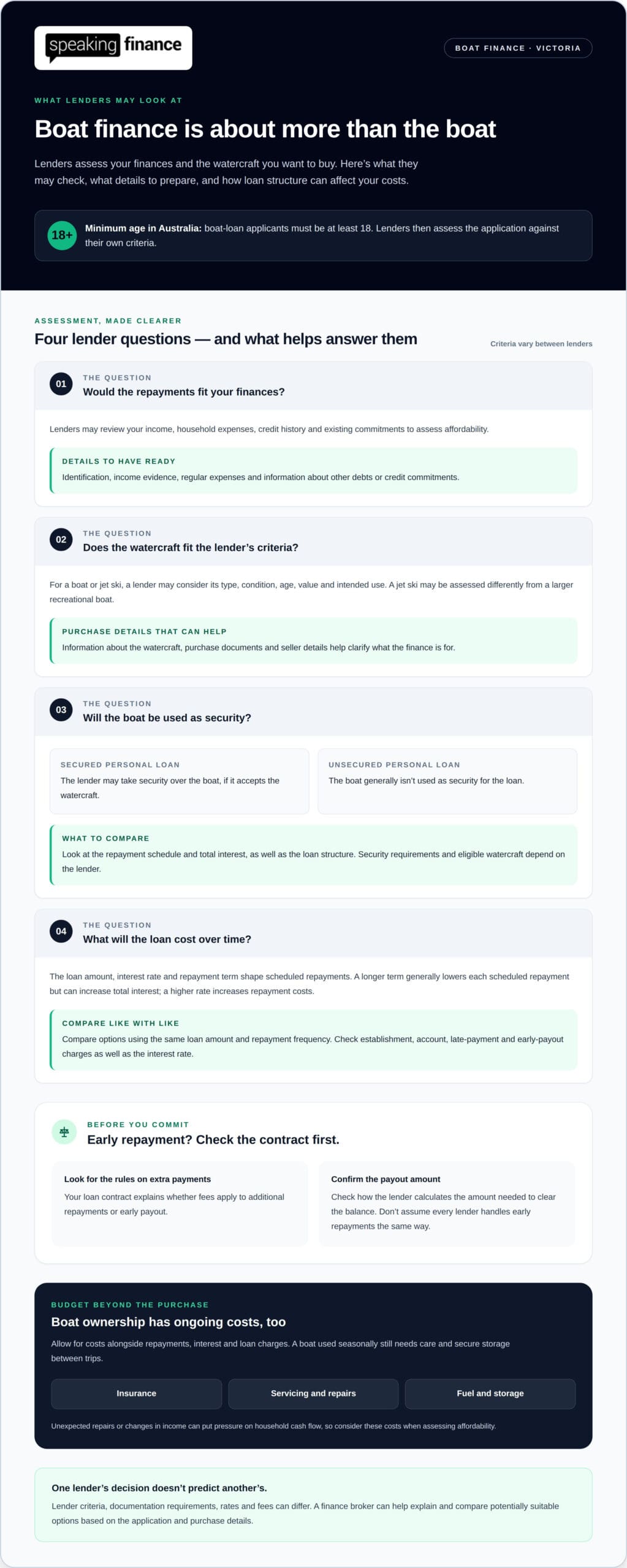
The boat itself isn’t the only thing lenders look at. For boat finance VIC, applicants must be at least 18 years old, and lenders generally assess the application alongside details about your finances and the boat you want to buy.
It’s reasonable to want a clear idea of what to prepare before applying for boat finance in Victoria. You’ll learn what information lenders may request, how they assess eligibility, and how secured and unsecured loans may work for a boat or jet ski.
We’ll also cover how loan structure and early repayments can affect your choices, and how a finance broker like Speaking Finance can help make sense of different lender requirements. This can give you a clearer picture of the next steps without assuming every option or advertised rate will suit your circumstances.
Key Takeaways
- Understand how your loan amount and repayment term shape repayments, and what to consider before paying the loan off early.
- Learn what to compare when weighing a secured personal loan, including how fees and charges can affect the overall cost.
- Get a clearer picture of the financial and purchase details lenders may assess when reviewing an application.
- Explore how finance options can differ for boats and jet skis, and how a broker can help compare potentially suitable options.
Can I repay my boat loan sooner?
Whether you can repay a boat loan early depends on your loan terms. The term and interest rate affect repayments: a longer term generally lowers each scheduled repayment but can increase total interest, while a higher rate increases repayment costs.
Fees and early repayment
Before making extra repayments, read the loan contract’s rules for additional payments and early payout. It explains whether fees apply and how the lender calculates the amount needed to clear the balance.
Review the fee schedule for establishment, ongoing account or early payout charges. A broker can explain how these costs affect the loan’s overall cost, helping you weigh the benefit of paying sooner against any charges. Don’t assume every lender handles early repayments the same way.
Term and interest rate effects
The loan amount, interest rate and repayment term all shape your scheduled repayments. A longer term spreads the amount borrowed across more payments, while a shorter term means paying it back sooner. The rate determines how much interest accrues on the outstanding balance.
Compare options using the same loan amount and repayment frequency. This makes it easier to see the effect of a different term or rate instead of comparing mismatched estimates.
A broker estimates repayments by considering the amount you need, the proposed term, the rate and applicable fees. It’s an example, not a quote for your boat purchase.
Ask for estimates at the repayment frequency you expect to use, such as monthly, and confirm the available payment methods. The loan schedule sets the due dates and amounts; the lender’s arrangements determine how repayments are made.
A calculator can show how changing the loan amount or term affects an estimate. A broker can also explain the assumptions behind the figures, including whether fees are included and how the dealer’s purchase details affect the amount being financed.
Can I use a Secured Personal Loan to finance my boat?
A secured personal loan may fund a boat purchase if the lender accepts the boat as security. Across Australia, banks, specialist lenders and marine finance brokers may arrange boat loans, with available options shaped by lender criteria.
Loan terms and finance amounts
A personal loan’s amount and term depend on the purchase, your contribution and the lender’s assessment. With a secured option, the lender may take security over the boat; an unsecured personal loan generally doesn’t use the boat as security. Compare the repayment schedule and total interest, not just the amount deposited at settlement. Choose a term that suits your budget and expected ownership period.
Fees and charges
Review the loan offer for establishment charges, ongoing account fees, late-payment charges and any early payout fee. The interest rate alone doesn’t show the full cost. A broker can explain when each fee applies, how it’s charged and whether it’s added to the loan balance. Compare fees alongside repayments to understand the total payable across options.
Approval and funding timeframes
A broker supports the application by gathering income details, liabilities, identification and the boat’s purchase information, then matching these against lender requirements. Lenders assess affordability and credit history before deciding whether an application can be approved. Funding follows approval and completion of lender conditions, including security paperwork. Processing depends on application completeness, lender workload and how quickly sale and boat details are confirmed. A broker can match a loan to your circumstances.
Financing risks and ongoing costs
Financing adds repayments to the ongoing cost of owning a boat. Budget for insurance, servicing, repairs, fuel and storage, alongside interest and loan charges. A boat used seasonally still needs care and secure storage between trips. If your income changes or unexpected repairs arise, scheduled repayments can put pressure on household cash flow. Consider these costs alongside the purchase price when assessing affordability.
Boat finance eligibility and lender assessment
In Australia, boat-loan applicants must be at least 18 years old. Lenders also assess credit, income, expenses, existing commitments and the watercraft being financed; their criteria vary.
Credit eligibility requirements
A lender reviews your credit history and current financial commitments to assess your application. Regular income and household expenses help show whether repayments fit your budget. Existing loans or credit card balances may also affect the assessment. Lenders apply their own criteria, so one lender’s decision doesn’t automatically predict another’s.
Eligibility criteria
Beyond the minimum age of 18, lenders consider your overall financial situation and the proposed loan. They may ask for identification, income evidence, details of regular expenses and information about other debts. The boat’s purchase details help establish what the application covers. Clear, consistent information helps the lender assess affordability and decide whether the proposed amount and repayments fit its criteria.
Eligible watercraft
Finance may cover boats and jet skis, but eligible watercraft depend on the lender and loan structure. The lender may consider the craft’s type, condition, age, value and intended use. These details can affect whether it qualifies as security. For example, a jet ski may be assessed differently from a larger recreational boat, depending on lender criteria.
For a secured loan, the lender considers both your application and the asset offered as security. Purchase documents, seller details and identifying information help clarify the transaction. If the watercraft doesn’t fit one lender’s criteria, another may assess it differently. Interest rates, fees and charges can also depend on the loan structure and your circumstances.
Boat and jet ski financing in Australia
Across Australia, boat finance options may include a secured boat loan or an unsecured personal loan. The suitable structure depends on the purchase, the watercraft and your financial circumstances.
A secured loan uses the boat or jet ski as security; an unsecured loan doesn’t. This can affect the lender’s assessment, interest rate and available terms. For example, a buyer purchasing a used boat privately may need different paperwork from someone buying through a dealer.
Dealerships may arrange finance through a limited lender panel. It can be useful to understand options beyond the finance offered at the point of purchase. Lenders assess watercraft, applicants and loan structures under their own criteria, so an estimate from one lender won’t represent every available option.
Start by matching the finance type to how you’ll use the watercraft. A personal purchase may suit a personal loan, while business use may call for a commercial finance structure. The lender may consider the boat’s age, condition, value and seller, alongside your income, expenses and existing commitments.
For a practical comparison, request estimates based on the same purchase price, deposit, loan amount and repayment frequency. Then compare the interest rate, fees and charges, term, repayment flexibility and total payable. A lower scheduled repayment may reflect a longer term, so consider the full repayment picture rather than one figure.
For a jet ski, include any trailer or accessories in the purchase details if they’re part of the finance request. Confirm what the loan covers and how the lender treats each item. Clear details help ensure the application reflects the actual purchase rather than an incomplete estimate.
The key takeaway: compare finance options beyond the dealer’s panel, then weigh the full loan structure against your circumstances.
Speaking Finance
Speaking Finance can help you understand potentially suitable boat finance options and how lender requirements relate to your circumstances. As a finance brokerage, it can help compare available options, explain differences in documentation and loan structures, and support you through the application process. This may be useful if you’re weighing a secured loan against an unsecured option or want help understanding repayment estimates.
The suitable option depends on your purchase, finances and the lender’s criteria. Speaking Finance can help you consider these factors without treating an advertised rate or one lender’s requirements as the whole picture.
Talk to Speaking Finance about your boat finance options.
Make your next step a considered one
Choosing boat finance starts with a clear view of what you need from the purchase. Consider how often you’ll use the boat, whether it’s for personal or business purposes, and what repayment commitment feels manageable alongside your other costs. These details can shape a conversation about suitable lending structures, rather than focusing only on an advertised rate.
Speaking Finance can help you understand available options and how lender requirements relate to your circumstances. As a brokerage, it can compare potentially suitable finance solutions and explain the differences in plain English. The right fit depends on your needs and the lender’s assessment, so discussing your situation can help before you settle on a structure.
A thoughtful next step can make the financing side clearer and help you plan for time on the water.
Frequently Asked Questions
What do I need to apply?
Have a clear purchase figure and be ready to explain how you’ll use the boat. If you’re considering a business purchase, distinguish that purpose from personal use when discussing finance. This helps frame the enquiry from the outset. Lenders may request different supporting information, so expect possible follow-up questions to clarify details.
How do I make repayments?
Follow the payment method and schedule in your loan agreement. Plan repayments around your regular cash flow, and keep enough funds in the nominated account before each due date. If a payment may be difficult, contact the lender early to discuss the situation rather than waiting until you miss it. Keep a record of payments so you can query any discrepancy.
How long can my loan be?
There isn’t one standard maximum term for boat loans. Before choosing an available term, consider whether you expect to keep the boat for that long and how the loan fits your plans. If you might sell the boat before the loan ends, check how the contract handles payout at sale. The lender’s offer sets the term and repayment conditions.
How long does approval take?
There’s no single approval timeframe for every application. Ask which stage the application has reached and whether anything remains outstanding. For example, a lender may still be reviewing a detail before making a decision. Keep the purchase timeline flexible where possible, and don’t treat an initial discussion as final approval.
How much can I borrow?
The lender decides the maximum amount it may offer after assessing your application. This may differ from the amount you request, so consider a backup purchase plan in case the approved amount is lower than expected. You might look at a different boat or adjust your contribution. A broker can help explain the lender’s decision and available options.
How much can I finance?
The amount you can finance is what the lender agrees to provide towards the purchase, not necessarily the boat’s full asking price. Decide how much you’re comfortable contributing yourself before settling on a finance request. For example, you could seek finance for only part of the purchase. The lender’s offer sets the approved amount and conditions.

Article by
Steven Emms
Steven Emms is the Director of Speaking Finance, an Australian finance brokerage based in Melbourne, Victoria.
Steven and his team help consumers, sole traders and businesses navigate vehicle finance, equipment finance, business lending, working capital and personal finance. His approach is simple: explain finance in plain English, cut through unnecessary jargon and help clients make informed decisions.
At Speaking Finance, the philosophy is simple: **We make finance black and white.**
Outside of finance, Steven is a long-suffering Essendon supporter, which has given him plenty of practice managing expectations and dealing with disappointment.
Disclaimer
The information in this article is general in nature and is provided for educational purposes only. It does not take into account your personal circumstances, financial situation, needs or objectives and should not be relied upon as personalised financial or credit advice.
Speaking Finance is a finance brokerage, not a direct lender. Finance products, interest rates, fees, terms and eligibility criteria vary between lenders and are subject to individual assessment, applicable lending policies and approval. No finance approval or particular outcome is guaranteed.
Information is believed to be accurate at the time of publication but may change. Before making financial decisions, consider your circumstances and seek appropriate independent professional advice where necessary.