The right truck finance option isn’t simply the one with the smallest repayment. In Australia, truck financing can use structures such as a chattel mortgage, commercial hire purchase, finance lease or operating lease. They differ in ownership, repayments and what happens when the agreement ends.
It’s easy to focus on the truck and leave the finance structure until later. But the structure matters: one option may suit a business that wants to own the truck, while another may better match its cash flow or plans to replace the vehicle.
This guide compares the main options and explains what to consider, including ownership, repayments, lender requirements and the truck’s age. You’ll also learn how a finance broker can help compare options across lenders, making the decision clearer and easier to understand.
Key Takeaways
- Choose repayments that fit your business cash flow, and understand what the lender considers when assessing your ability to service the loan.
- Prepare relevant business and financial documents, as trading history and lender requirements can affect options for newer businesses.
- Understand how a balloon payment or residual value changes what you owe at the end of the agreement, and get tax guidance from your accountant.
- Compare ownership, repayment structures and lender requirements to find an option that suits the truck and your business plans.
What happens if I can’t make payments on my truck loan?
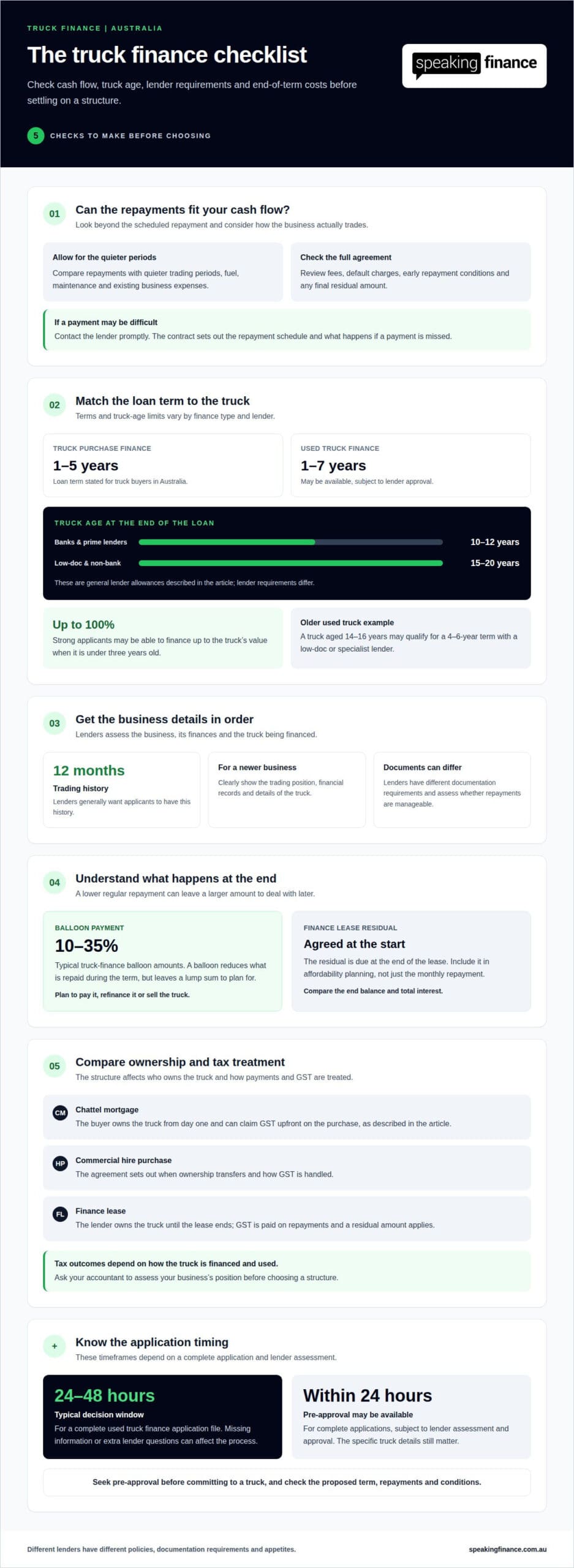
If a repayment is becoming difficult, contact the lender promptly to discuss your situation. The loan contract sets out the repayment schedule and what happens if you miss a payment.
Repayment affordability and loan servicing
Loan servicing means assessing whether income and available cash flow can cover regular repayments alongside other commitments. Before choosing a truck loan, compare the scheduled repayment with quieter trading periods, fuel and maintenance costs, and existing business expenses. Repayments continue until the loan is fully paid off.
If cash flow changes, speak with the lender before a payment is due rather than waiting until you fall behind. Ask how the contract treats missed payments and whether any available repayment options would change the total amount payable.
What risks, hidden costs and early repayment fees should you check? Read the agreement for fees, default charges, early repayment conditions and any final residual amount. These terms affect the overall cost and flexibility of truck finance.
Loan terms and repayment flexibility
Truck buyers in Australia can spread the purchase cost over a loan term of 1-5 years. Used truck finance may run for one to seven years, subject to lender approval. A longer term spreads repayments over more time, while a shorter term means paying the balance down sooner.
Finance leases have fixed monthly repayments during the contract, with a residual value agreed at the start. This amount is due at the end, so include it in your affordability planning rather than focusing only on the monthly figure. Hire purchase is another structure to compare.
Loan-to-value ratios affect how much of the truck’s value a lender may finance. Strong applicants may be able to finance up to 100% of a truck’s value when it’s under three years old. Lender tiers also differ: Australian banks and prime lenders typically require the truck to be no older than 10 to 12 years at the end of the loan. Low-doc and non-bank lenders generally allow 15 to 20 years. For example, a used truck aged 14 to 16 years may qualify for a four-to-six-year term with a low-doc or specialist lender. A broker can help compare truck and trailer finance structures across lenders.
Can I get truck finance as a new business owner?
Yes, a new business can apply, but lenders assess its trading history, finances and truck details. A broker can help prepare the application, match it with lender criteria, submit it and explain the decision.
Approval documents and business eligibility
Lenders generally want applicants to have twelve months of trading history. For a newer business, the application should clearly show its trading position, financial records and the truck being financed. The lender uses these details to assess whether the business can manage repayments. A broker can organise the relevant information and present the application against lenders’ different documentation requirements.
Finance rates and approval decisions
A higher credit score generally improves the chance of approval and may lead to a better interest rate. Indicative Australian non-bank or low-doc rates for used truck finance are around 8% to 14% per annum as at July 2026. Advertised truck finance rates can vary depending on the lender and applicant. These figures are not directly comparable: lender, applicant, truck and loan term all shape the offer. A chattel mortgage is one structure to consider, with ownership and repayment terms forming part of the comparison.
Approval timeframes
Once a used truck finance application file is complete, decisions typically come back within 24 to 48 hours. Missing information or extra lender questions can affect the process. A broker can help gather the required details, submit the application and respond to follow-up requests. That keeps the file moving, but approval still depends on the lender’s assessment of the business and truck.
Pre-approval timing
Seek pre-approval before committing to a truck, so you have an indication of your borrowing position while considering options. For complete applications, pre-approval may be available within 24 hours, subject to lender assessment and approval. A broker can explain the proposed loan term, repayments and conditions before you proceed. The final truck details still matter, so allow time for the lender to assess the specific vehicle.
To discuss how a broker can help with your application, talk through your truck finance options.
Are there tax benefits or deductions for truck financing?
Tax outcomes depend on how the truck is financed and used, so a lower monthly repayment doesn’t automatically mean a better tax result. A chattel mortgage, hire purchase and finance lease can treat ownership, GST and payments differently. Ask your accountant to assess your business’s position before choosing a structure.
With a chattel mortgage, the buyer owns the truck from day one and can claim GST upfront on the purchase, as described in the relevant finance information. Commercial hire purchase terms can set out when ownership transfers and how GST is handled. A finance lease keeps ownership with the lender until the lease ends, with GST paid on repayments and a residual amount applying. These differences matter when planning transport expenses and the vehicle’s role in the business.
A balloon payment leaves part of the loan balance to pay at the end, reducing the amount repaid during the term. Typical truck-finance balloon amounts range from 10% to 35%. That can ease monthly cash flow, but the business still needs a plan to pay the lump sum, refinance it or sell the heavy vehicle. Compare the total interest and end-of-term balance, not just the regular repayments.
A finance lease also includes a residual value. Under Taxation Determination TD 93/142, a three-year finance lease on an asset with an eight-year effective life has a minimum residual value of 46.88% of cost. This specific tax rule illustrates why a residual isn’t simply an optional final repayment. Your accountant can explain how the determination applies to your circumstances.
A truck-finance down payment is typically 20% of the truck’s value, or the applicant may be a homeowner. The amount a lender will finance also depends on its assessment of the applicant and vehicle. Before deciding how much to borrow, compare the deposit, interest rate, monthly repayments and any balloon or residual together. An independent accountant can help assess tax treatment; a broker can explain the finance structure, but can’t provide tax advice.
Lender comparison and broker services
Australian truck finance offers vary by lender, applicant and vehicle. A useful comparison looks beyond the interest rate: consider the repayment structure, fees, deposit, loan term, any balloon or residual, and the contract’s end-of-term requirements. A rate alone doesn’t show how well an agreement fits your business plans or cash flow.
Indicative rates for used truck finance range from 7.45% to around 9% per annum with bank or prime lenders, as at July 2026. Specialist or adverse-credit lenders are around 12% to 18% per annum and above, as at July 2026. These ranges aren’t individual quotes. The lender’s assessment, truck and application details affect the terms offered.
A broker can compare potentially suitable options and explain differences in lender policies, documentation requirements and lending criteria. This can help if a lender’s requirements don’t fit your circumstances or another lender may assess the application differently. A broker can also help organise information and present it to lenders, while you decide which structure suits your business.
Compare agreements on the same basis. Review the full repayment schedule and any final amount due, not just the regular repayment. Check which fees apply, how early repayment is treated, and what happens if you sell the truck before the loan ends. Read the contract carefully to understand your obligations before committing.
A broker can clarify which details may need explaining to a lender and how the proposed terms fit together. A quicker process is useful only if you understand the interest rate, repayment commitments and end-of-term obligations before signing.
Speaking Finance: Truck Finance
Speaking Finance can help you compare truck finance options when you’re weighing lender requirements, ownership structures and repayments. As a finance brokerage, it connects clients with more than 70 lenders and helps them understand potentially suitable options for their circumstances.
You can discuss the truck, how it will be used, your business position and the repayment structure you’re considering. Speaking Finance can explain how lender policies differ and guide you through the application process. The aim is to make your options clearer, not to promise approval or assume one lender will suit every buyer.
If you’re ready to talk through your next step, contact Speaking Finance.
Choose finance that fits the work ahead
Choosing a truck is a business decision, but the finance structure shapes how the purchase fits your plans. Before taking the next step, consider how the vehicle will earn its keep, what repayments your cash flow can support, and whether you prefer ownership now or at the agreement’s end. These priorities give a lender comparison a practical starting point, rather than leaving you to compare interest rates in isolation.
For truck financing, match the proposed structure with your operating plans and intended use of the truck. Speaking Finance can explain available options and connect you with potentially suitable lenders. It also offers car finance, business loans and personal loans for other borrowing needs.
Bring questions about the truck, your business and your preferred repayment approach to the discussion. Clear priorities make it easier to identify which options deserve a closer look.
A considered choice can help keep your finance aligned with the work ahead.
Frequently Asked Questions
What are the different types of truck financing available?
Common structures include a chattel mortgage, commercial hire purchase, finance lease and operating lease. The right comparison depends on how you want to use the truck and what you plan to do with it at the agreement’s end. If you’re considering more than one structure, compare the written terms side by side before deciding.
What credit score is needed to qualify for truck financing?
There isn’t one credit score that applies across every Australian lender. A credit score is one part of an application, not a stand-alone pass or fail. Lenders also assess the applicant and proposed finance together. If you’re unsure how your credit history may affect an application, a broker can explain options for discussion with lenders.
Bank or broker?
A bank assesses applications under its own policies, while a broker can help present an application to potentially suitable lenders. A broker can also explain lender requirements in plain English and manage questions or document requests during the process. The choice comes down to whether you prefer dealing directly with one lender or getting help considering different lending pathways.
Can I finance a used truck bought at auction or privately?
It may be possible, but the lender assesses the particular truck and purchase arrangement. Before committing, gather the vehicle details and sale information so the proposed purchase can be considered. Auction and private purchases can involve different transaction details, so allow time to understand lender requirements before agreeing to buy.
Can I only finance trucks or other equipment too?
You can enquire about finance for equipment as well as trucks. Speaking Finance offers equipment finance, which may be relevant if your business plans to acquire another work asset. The truck and equipment can be considered as separate finance needs, so proposed funding can reflect each asset and its role in your operations.
Do I need a deposit for a used truck?
A deposit may be required, but there isn’t one deposit rule for every used-truck application. The lender considers the applicant and vehicle when assessing the finance. If you’re working to a set purchase budget, include the deposit and any transaction costs in your planning before committing to the seller.

Article by
Steven Emms
Steven Emms is the Director of Speaking Finance, an Australian finance brokerage based in Melbourne, Victoria.
Steven and his team help consumers, sole traders and businesses navigate vehicle finance, equipment finance, business lending, working capital and personal finance. His approach is simple: explain finance in plain English, cut through unnecessary jargon and help clients make informed decisions.
At Speaking Finance, the philosophy is simple: **We make finance black and white.**
Outside of finance, Steven is a long-suffering Essendon supporter, which has given him plenty of practice managing expectations and dealing with disappointment.
Disclaimer
The information in this article is general in nature and is provided for educational purposes only. It does not take into account your personal circumstances, financial situation, needs or objectives and should not be relied upon as personalised financial or credit advice.
Speaking Finance is a finance brokerage, not a direct lender. Finance products, interest rates, fees, terms and eligibility criteria vary between lenders and are subject to individual assessment, applicable lending policies and approval. No finance approval or particular outcome is guaranteed.
Information is believed to be accurate at the time of publication but may change. Before making financial decisions, consider your circumstances and seek appropriate independent professional advice where necessary.