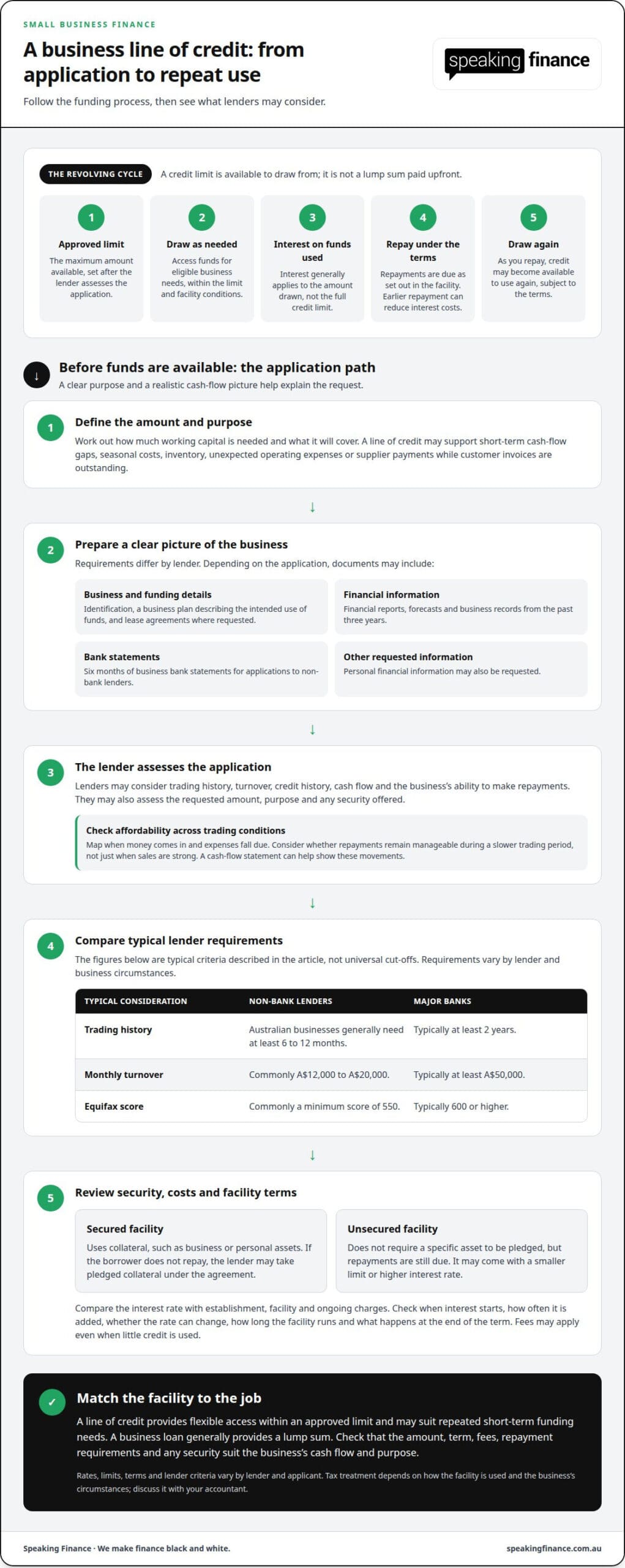
A credit limit isn’t a lump sum you have to take all at once. A business line of credit for a small business in Australia is a revolving facility that lets you borrow up to an approved limit. You draw funds when needed, pay interest on the amount borrowed, then may draw again as you repay, subject to the facility terms.
This flexibility can help when customer payments arrive after expenses are due or cash flow varies by season. But access to revolving credit doesn’t automatically make it the right fit. Consider the costs, repayment terms and purpose of the funding.
This guide explains how business lines of credit work and what to consider before applying. It also compares them with business loans and credit cards, explains when each option may suit a small business, and outlines how a finance broker can help you understand potential options.
Key Takeaways
- Understand how a revolving credit facility works, including why interest is charged on the amount drawn rather than the full limit.
- Weigh the trade-off between offering assets as security and applying for an unsecured facility.
- See which parts of your business’s financial position lenders may consider when assessing an application.
- Match the funding structure to your need by comparing flexible credit access with a lump-sum business loan or a credit card.
What is a business line of credit?
A business line of credit is a revolving facility: draw funds up to an approved limit, repay them, then draw again as credit becomes available. It may support short-term working capital needs, such as managing cash flow gaps or buying inventory.
Interest on drawn funds
Interest generally applies to the amount used, rather than the full credit limit.
A similar principle may apply to overdraft funds used through a business account. Check how the lender calculates interest, including when charges start and how often interest is added. Repaying funds earlier can reduce interest costs and restore available credit.
Credit limits, rates and terms
The credit limit is the maximum amount available to draw, not a lump sum paid upfront. A business can access funds as needed, provided the balance stays within that limit and the facility’s conditions are met. The lender sets the limit after assessing the business and its application.
Rates, facility terms and repayment requirements vary by lender and applicant. Before accepting an offer, check how long the facility runs, whether the rate can change and what happens at the end of the term. A higher limit may not be useful if the business needs less working capital.
Affordability, interest and fees
Start by mapping the business’s cash flow: estimate when money comes in and when expenses fall due. Consider whether repayments would remain manageable during a slower trading period, not just when sales are strong. A cash flow statement can help show these movements.
Compare the interest rate with establishment, facility and ongoing charges. Interest on drawn funds can be useful, but fees may apply even when little credit is used. A line of credit may also cost more over the long term, so consider whether the limit and term match the need.
Are business line of credit interest and fees tax-deductible for Australian businesses? There isn’t one answer for every business. Tax treatment may depend on how the facility is used and the business’s circumstances. Discuss the treatment with your accountant.
What are the risks and repayment rules? The business must repay borrowed funds under the facility’s terms, and interest or fees can increase the total cost. Using revolving credit for a long-term investment may mean costs continue over time. Repaying drawn funds earlier can reduce interest and free up credit.
Secured and unsecured facilities
Australian banks and non-bank lenders offer business lines of credit, with varying eligibility rules and security requirements. A secured facility uses collateral, such as business or personal assets. An unsecured facility doesn’t require assets to be pledged, although lenders still assess the business’s finances and ability to repay.
Security can affect the limit and rate offered. Secured facilities may have different limits and rates from unsecured options. The lender’s assessment, including any valuation, determines the amount available.
With an unsecured facility, the business avoids pledging a specific asset, but may face a smaller limit or higher interest rate. These are market ranges, not a promise of what any business can borrow.
Business loans and lines of credit don’t have the same structure. A business loan generally provides a lump sum, while a line of credit gives access to funds within an approved limit. When considering an offer, check the facility type, security requirements and repayment terms.
Security affects the risks as well as the terms. If a borrower doesn’t repay a secured facility, the lender may take pledged collateral under the agreement. Unsecured borrowing doesn’t require pledged assets, but repayments are still due. Consider whether pledging an asset is acceptable and how repayments fit the business’s cash flow.
Compare options by considering the amount needed, interest rate, fees, repayment terms and assets involved. A business seeking short-term working capital may weigh these factors differently from one funding a longer-term purchase. Explore business finance options to understand which structure may suit the need.
Eligibility requirements
To apply, define the amount and purpose, gather the relevant financial records and submit an application. The lender assesses factors such as trading history, turnover, credit history, cash flow and repayment capacity before deciding whether to approve the facility.
Requirements differ by lender and business circumstances. Australian businesses generally need at least 6 to 12 months of trading history, while major banks typically look for at least 2 years. Non-bank lenders commonly request monthly turnover of A$12,000 to A$20,000; major banks typically look for at least A$50,000 per month.
Credit history is another consideration. Non-bank lenders commonly set a minimum Equifax score of 550, while major banks typically look for 600 or higher. These are typical criteria, not universal cut-offs. A lender also considers whether the business can make payments from its cash flow.
Prepare documents that give a clear picture of the business. Depending on the lender, these may include:
- Identification and business plans describing the intended use of funds.
- Financial reports, forecasts and business records from the past three years.
- Six months of business bank statements for applications to non-bank lenders.
- Lease agreements and personal financial information, where requested.
The purposes eligible for a business loan or line of credit depend on the lender and facility. A revolving limit may support short-term working capital, seasonal cash flow gaps or unexpected operating costs. A clear purpose, such as covering supplier payments while customer invoices are outstanding, helps explain the request. Interest generally applies to funds used, but repayments still need to fit the business’s cash flow.
Comparing credit lines, business loans and credit cards
The right business finance depends on what the money needs to do. A credit line may suit repeated short-term funding needs, while a business loan may better match one defined purchase. A business credit card can cover eligible card expenses. Compare repayment structures and total charges, not just the interest rate.
A line of credit lets a business draw funds as required, repay them and access available credit again. For example, a business with uneven customer payments might use it to cover supplier expenses, then repay it as invoices are paid. This flexibility may help manage cash flow, but the business needs to track its balance and follow the facility conditions.
A business loan generally provides a lump sum upfront, repaid in instalments over an agreed term. It may suit a specific investment, such as equipment, when the business knows the amount required. Interest is charged on the outstanding amount. Before applying, consider whether the repayment schedule fits expected income.
A credit card can be practical for regular, smaller purchases made directly with suppliers, such as fuel or business subscriptions. The credit limit, interest rates, fees and repayment conditions depend on the card and provider. Check how interest applies to purchases and whether account charges apply, especially if the balance may not be cleared promptly.
To compare options, start by identifying the expense and how long funding is needed. Then compare the available limit or lump sum, interest rate, fees, repayment timing and flexibility. A hypothetical offer with a 14.5% interest rate and a 1.5% facility fee shows why the headline rate alone doesn’t tell the full cost. Those figures are an example, not a quote.
For recurring cash flow gaps, a credit line may provide repeat access to funds. For a one-off, larger investment, a business loan may offer a clearer repayment structure. For routine card purchases, a credit card may be more convenient. Let the business’s income pattern and capacity to meet repayments guide the choice.
Speaking Finance: Business Lines of Credit
Speaking Finance helps Australian businesses understand business line of credit options and explore potentially suitable finance through its lender panel. As a finance broker, Speaking Finance can help you compare lender policies, documentation requirements and facility structures.
A line of credit may suit recurring cash flow gaps, while a business loan may fit a specific purchase with a known cost. The right structure depends on your funding purpose, cash flow and capacity to manage repayments. Speaking Finance connects clients with more than 70 lenders, giving businesses options to consider rather than assuming one lender will suit every situation.
If you’re weighing a business line of credit against another form of business finance, Speaking Finance can help you understand your options.
Choose a funding structure that fits your next step
Before deciding whether a business line of credit for a small business fits, write down what the funding needs to cover and when the expense is due. Then consider how the business expects to repay what it borrows. A clear view of the purpose and timing gives you a practical starting point for your finance decision.
If your plans change or the funding need becomes clearer, revisit the structure before moving ahead. Taking time to consider the decision can help you approach the next step with confidence.
A considered choice can help keep your business moving.
Frequently Asked Questions
How does an LOC work?
An LOC, or line of credit, gives a business access to an approved borrowing facility. The business can draw funds as needed and repay them under the lender’s terms. For example, a retailer might use available credit to pay a supplier before a busy period, then repay it as sales revenue arrives. The facility terms set out how access and repayments work.
How can a business loan help grow my business?
A business loan can fund a planned investment, such as equipment, stock or a new site. That funding may help a business increase capacity or serve more customers, but growth isn’t automatic. Before borrowing, estimate the investment’s costs and likely effect on cash flow. Then consider whether the business can meet repayments if sales take longer to build.
What is a business line of credit and how does it work for a small business?
A business line of credit for a small business provides flexible access to funds up to a lender-approved limit. It may help manage changing expenses, such as supplier deposits due before customer payments arrive. The business can draw what it needs, subject to the facility terms, and manage the balance as its cash position changes.
What are the current interest rates, fees and credit limits for Australian business lines of credit?
Rates, fees and limits vary between lenders and applications, so no single figure applies to every Australian business. Compare the interest rate, facility and ongoing fees, whether the rate can change, and any charges linked to unused credit. Also consider repayment terms and whether the facility is secured, as these factors affect the offer.
What eligibility criteria and documents do Australian lenders require?
Australian lenders assess each application using their own criteria, which can include trading history, turnover, credit history and the business’s capacity to repay. They may request identification, financial records, bank statements, forecasts or a business plan. Presenting consistent figures across your application and documents helps explain how the requested facility fits the business’s purpose and finances.
How do lenders assess a small business line of credit application in Australia?
Lenders consider both the business’s ability to manage the facility and its reason for seeking funds. They may review income patterns, existing financial commitments, account conduct, credit history and supporting documents. For example, a business with seasonal sales can explain how quieter periods affect cash flow and how it plans to manage repayments through those cycles.

Article by
Steven Emms
Steven Emms is the Director of Speaking Finance, an Australian finance brokerage based in Melbourne, Victoria.
Steven and his team help consumers, sole traders and businesses navigate vehicle finance, equipment finance, business lending, working capital and personal finance. His approach is simple: explain finance in plain English, cut through unnecessary jargon and help clients make informed decisions.
At Speaking Finance, the philosophy is simple: **We make finance black and white.**
Outside of finance, Steven is a long-suffering Essendon supporter, which has given him plenty of practice managing expectations and dealing with disappointment.
Disclaimer
The information in this article is general in nature and is provided for educational purposes only. It does not take into account your personal circumstances, financial situation, needs or objectives and should not be relied upon as personalised financial or credit advice.
Speaking Finance is a finance brokerage, not a direct lender. Finance products, interest rates, fees, terms and eligibility criteria vary between lenders and are subject to individual assessment, applicable lending policies and approval. No finance approval or particular outcome is guaranteed.
Information is believed to be accurate at the time of publication but may change. Before making financial decisions, consider your circumstances and seek appropriate independent professional advice where necessary.