Limited trading history is one part of a truck finance application, not the whole story. Truck finance for a new business can feel uncertain when there’s little financial history to show a lender, particularly when repayments need to fit an early-stage cash flow. A clear application explains why the truck is needed, how it supports the work and how the business could manage the repayments alongside its other costs.
This article covers what to consider when exploring finance, including the truck’s business purpose, available records and repayment plan. Lender policies and documentation requirements differ, so there isn’t one set of criteria for every new business.
You’ll also find practical ways to prepare for a finance discussion and compare potential pathways. A truck finance broker can help explain the options, while the lender assesses the application and makes the credit and pricing decisions.
Key Takeaways
- Explain how the truck will support the business, including the work it will be used for and why its capacity suits that work.
- Compare finance structures by ownership, repayment schedule, any final payment and what happens at the end of the term.
- Organise business details, available trading records, cash-flow information and truck purchase details. Document requests vary.
- With truck finance for new business, a broker can explore potentially suitable pathways, while the lender makes the credit and pricing decisions.
Truck finance for a new business: why the early stage matters
Truck finance for a new business depends on the applicant’s circumstances and the lender’s assessment. With a short trading history, there may be less business income information to show. Lenders differ in the evidence and situations they consider, so it helps to explain the truck’s purpose, the business plan and any available records together.
Truck finance for a new business is business asset finance used to fund a truck for work, with a lender assessing the application based on the business and applicant’s circumstances. It can help fund a work vehicle, but it does not guarantee an approval or a particular outcome.
What counts as a new business?
An early-stage business might have a recently established ABN, limited trading records or have only just started taking on work. This can include a sole trader setting up independently or a new contractor preparing to fulfil jobs. Being newly established doesn’t mean having no business purpose. A clear operating plan can explain what work the business intends to do and how the truck fits in. There’s no single trading-history threshold that applies across all lenders.
Why the truck’s business purpose matters
Explain the connection between the truck and the work. Will it carry tools or materials, transport goods, or help deliver contracted services? For example, a new contractor could describe the jobs they expect to undertake and why the truck’s capacity suits them. Keep the explanation practical and consistent with the business plan. Distinguish confirmed work from work you’re still pursuing, rather than presenting future income as certain.
A truck is generally understood as a commercial vehicle, but the lender assesses the full application and decides how it fits its credit and pricing criteria. Speaking Finance arranges truck finance and can explain possible business vehicle finance pathways, but the lender makes the decision. Explore truck finance options to understand how finance structures may vary for business use. For a broader comparison of structures and repayment considerations, see this guide to truck finance in Australia.
How truck finance options can differ for a new business
For truck finance for new business, asset finance is the broad category that can cover different ways to fund a work vehicle. The structure, terms and availability depend on the lender and the applicant’s circumstances. A product name alone won’t tell you how repayments work or what happens at the end of the agreement.
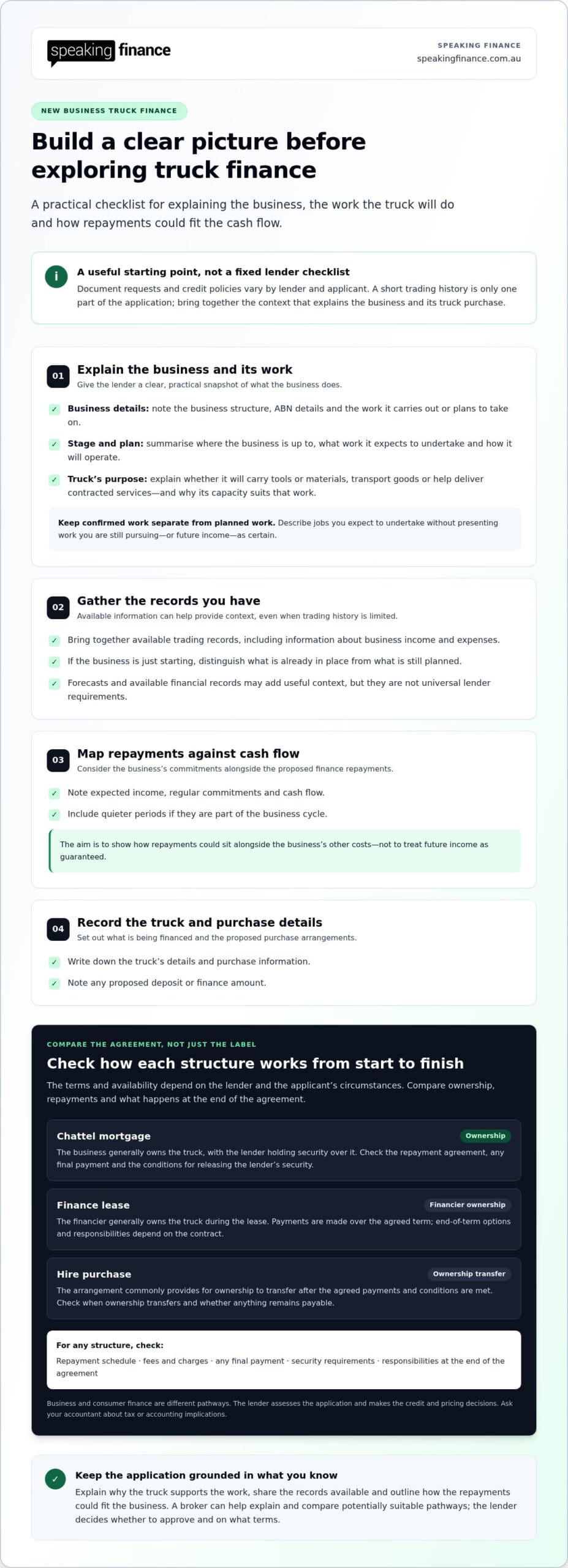
Compare finance structures by their actual terms, not their labels alone. The examples below are general. Contract details can differ, even when two options have the same name.
| Structure | Ownership | Repayments | End-of-term points |
|---|---|---|---|
| Chattel mortgage | The business generally owns the truck, with the lender holding security over it. | Regular repayments are set out in the agreement. | Check any final payment and the conditions for releasing the lender’s security. |
| Finance lease | The financier generally owns the truck during the lease. | Payments are made over the agreed term. | Options and responsibilities at the end depend on the contract. |
| Hire purchase | The arrangement commonly provides for ownership to transfer after the agreed payments and conditions are met. | Repayments follow the contract schedule. | Check when ownership transfers and whether anything remains payable. |
How different finance structures may work
A new business may have limited financial records, so consider what information a lender may request as well as the structure itself. Compare the repayment schedule, fees and charges, any final payment, security requirements and responsibilities at the end of the agreement. These details affect the overall cost and how the arrangement fits the business’s cash flow. For tax or accounting implications, speak with your accountant.
Business finance or personal finance?
The truck’s intended use and the applicant’s circumstances help determine whether a business or consumer finance pathway is considered. Business lending and consumer lending are different, and neither is automatically suitable just because a truck is involved. The lender assesses the application and sets its terms. For wider context, explore business loan options.
Speaking Finance can help explain and compare potential truck finance pathways. See how we can help.
What to prepare before exploring truck finance for a new business
Preparing a clear picture of the business and truck purchase can make a finance discussion more useful. Document requests for truck finance for new business vary by lender and applicant, so use this list as a starting point, not a fixed checklist. Different lenders have different policies and appetites, which is why requirements can vary. This small business vehicle finance lender information explains why one set of requirements won’t fit every case.
- Gather business details, including its structure, ABN details and the work it carries out or plans to take on.
- Bring together available trading records, including information about business income and expenses.
- Note expected income, regular commitments and cash flow, including quieter periods if they’re part of the business cycle.
- Record the truck’s details and purchase information, along with any proposed deposit or finance amount.
Build a clear picture of the business
Summarise what the business does, its stage, the work it expects to undertake and how the truck will be used. If you’re starting out, separate what’s already in place from what’s still planned. Forecasts and available financial records may provide useful context, but they aren’t universal lender requirements. For accounting or tax treatment, ask your accountant rather than relying on a general finance overview.
Organise truck and repayment information
Gather the truck’s make, model, year and condition where known, plus the seller’s details and any purchase information available. Then consider expected cash flow and existing commitments before estimating what repayments the business could manage. Include running costs such as fuel, insurance, servicing and registration in your calculations. Deposits, costs and terms vary, so base your plan on the actual terms presented rather than assumptions.
Having these details in one place gives you a practical starting point. Speaking Finance can explain lender requirements and explore finance options with you, while the lender assesses the application and makes its decision.
How a broker can help with new business truck finance
A broker can help you explore and compare potentially suitable truck finance pathways, explain lender requirements and organise an application. The lender makes the credit and pricing decisions. For a new business, broker support can make it easier to understand what information to provide and how different options may work, without promising approval or a particular result.
What happens when you work with Speaking Finance?
Speaking Finance’s process is practical and starts with your business situation:
- Understand your purpose, circumstances and objectives.
- Identify potentially suitable finance pathways and lenders.
- Explain key requirements and differences in plain English.
- Collect and organise the information required for an application.
- Present the application to appropriate lenders.
- Manage communication, questions and document requests through the approval process.
- Assist with documentation and settlement, and provide post-settlement support where relevant.
What a broker can and cannot decide
A broker can help identify and compare possible pathways, but each lender sets its own policies, documentation requirements, pricing and final terms. The lender assesses the application and decides whether to offer finance and on what terms. Broker support doesn’t guarantee approval, a particular rate or any other outcome.
A conversation can help clarify the process, the information a lender may need and the questions to consider as you weigh up your next steps. For more on the broker’s role in vehicle funding, read this asset finance broker guidance, or talk to Speaking Finance about your business situation.
Make your next truck decision with a clear plan
Starting a business often means making decisions before you’ve built a long trading record. Before committing to finance, consider whether the truck, the work you expect and the repayments could fit together. Account for the truck’s running costs and the business’s other commitments as well as the repayment itself. This gives you a more grounded basis for exploring truck finance for new business while your trading history is still taking shape.
A broker can explain potential pathways and the information a lender may need, while credit and pricing decisions remain with the lender. Speaking Finance is an Australian finance brokerage that supports business and consumer finance enquiries, with plain-English guidance and access to a broad panel of lenders. Its role is to help make the options easier to understand, not to promise a finance outcome.
Bring your questions and a straightforward picture of the business you’re building. Understanding the trade-offs can help you decide what to explore next, based on how the truck would fit your operation.
Frequently Asked Questions
Can a business apply for truck finance before it starts trading?
You can discuss a proposed truck purchase before trading starts, but whether a lender will assess an application at that stage depends on its policies and your circumstances. Be clear about what’s already arranged and what remains a plan. For example, distinguish confirmed work from jobs you’re still seeking, so the business outlook is presented accurately rather than as guaranteed income.
How long does a business need to be trading before applying for truck finance?
There’s no universal trading period that applies to every lender, and reaching a particular business anniversary doesn’t guarantee an outcome. Keep business records orderly from the start and note when trading began. That timeline can help explain how the business has developed and what information is available when you explore finance.
Can a sole trader explore truck finance for a new business?
Yes, a sole trader can explore finance for a truck intended for business use. Be ready to explain which business activity the truck supports and how you expect to use it. If it will also be used personally, make that clear. The lender considers the application under its own policies, so a sole trader’s business structure alone doesn’t determine the result.
Is an ABN enough to qualify for new business truck finance?
No. An ABN identifies a business, but it doesn’t by itself explain how a truck will be used or determine whether a lender will offer finance. Check that the business name and ABN details match the applicant’s details and supporting paperwork. If the business operates under a trading name, make that relationship clear in the information you provide.
What if my new business has no financial statements yet?
You can still discuss potential pathways. If you prepare projections, note the assumptions behind expected sales, timing and costs, and separate confirmed income from estimates. This helps present the business plan and its uncertainties clearly. The lender decides what information it needs to assess the application.

Article by
Steven Emms
Steven Emms is the Director of Speaking Finance, an Australian finance brokerage based in Melbourne, Victoria.
Steven and his team help consumers, sole traders and businesses navigate vehicle finance, equipment finance, business lending, working capital and personal finance. His approach is simple: explain finance in plain English, cut through unnecessary jargon and help clients make informed decisions.
At Speaking Finance, the philosophy is simple: **We make finance black and white.**
Outside of finance, Steven is a long-suffering Essendon supporter, which has given him plenty of practice managing expectations and dealing with disappointment.
Disclaimer
The information in this article is general in nature and is provided for educational purposes only. It does not take into account your personal circumstances, financial situation, needs or objectives and should not be relied upon as personalised financial or credit advice.
Speaking Finance is a finance brokerage, not a direct lender. Finance products, interest rates, fees, terms and eligibility criteria vary between lenders and are subject to individual assessment, applicable lending policies and approval. No finance approval or particular outcome is guaranteed.
Information is believed to be accurate at the time of publication but may change. Before making financial decisions, consider your circumstances and seek appropriate independent professional advice where necessary.