The truck that keeps your business moving shouldn’t leave you guessing about finance. Across Australia, truck finance can be arranged through different options, including a chattel mortgage, commercial hire purchase or finance lease. A 24-48-hour approval isn’t guaranteed, and timing depends on the application, documents and vehicle details.
It’s sensible to want clear repayments and a reliable idea of when your truck can be ready for work. Pre-approval can help you understand your borrowing position before committing to a purchase, but it isn’t the same as final approval or settlement.
This guide explains how the main finance structures differ, what lenders may consider during pre-approval and what can affect the time between approval and settlement. You’ll also learn how Speaking Finance can help you compare options across lenders, so you can make a decision with a clearer view of the terms and next steps.
Choosing a work truck is only part of the decision
Watch our Tiny Truck video below, then consider how your next truck purchase will fit your business.
Alongside choosing the vehicle, consider the finance repayments, fees, total amount payable and any balloon payment due at the end. The finance arrangement needs to work alongside your business’s other expenses.
Speaking Finance can help you explore truck finance in Melbourne and compare potentially suitable options based on your circumstances and the proposed purchase. Available terms depend on the lender’s assessment.
Considering a truck purchase?
Speak with Speaking Finance before submitting an application. We can help you understand which lender pathways may appear suitable for the truck and your business circumstances.
➡️ Discuss Your Truck Finance Options Today
Key Takeaways
- Adverse credit or no PAYG income proof doesn’t automatically rule out finance; lender policies and the applicant’s circumstances matter.
- Understand how a chattel mortgage, commercial hire purchase and finance lease differ in ownership and structure before choosing an option.
- Consider the finance term and any balloon payment together, as they affect regular repayments and the amount due at the end.
- Pre-approval and settlement are separate steps; complete, accurate documents and vehicle details can help keep the process moving.
Why Choose Us for Truck Finance Melbourne and surrounding areas?
Truck finance applications are assessed against the buyer, the vehicle and the proposed use. For a Melbourne business, preparing clear purchase and financial details helps the lender assess the request and identify any further information needed.
Eligibility with adverse credit or no PAYG proof
Adverse credit or a lack of PAYG payslips doesn’t automatically determine the outcome. An assessment may consider your wider financial position, income evidence, existing commitments and the truck’s role in the business. For example, a sole trader may provide business records instead of employee payslips. Document requirements vary between lenders and depend on the application.
No-deposit application criteria
No-deposit finance isn’t available on identical terms to every applicant. The lender assesses the requested amount alongside the truck’s details and your financial position. A deposit may affect the amount financed, but the lender decides how it factors into the application. Include purchase information and relevant financial records so the lender can assess the request as a whole.
Refinancing and multi-truck applications
For a refinance, set out the existing finance, truck details and your business’s current position. If you’re financing multiple vehicles, include each truck, its intended business use and the overall finance request. For example, a business adding a second delivery truck can explain how both vehicles support its operations. The lender assesses the application against its requirements and the information provided.
Rates, fees and repayment risks
Truck loan interest rates and fees vary by lender, applicant and circumstances, so there isn’t one typical rate for every Australian buyer. Banks and specialist finance providers may offer truck finance, while a broker can help compare potentially suitable options across lenders. The truck’s age, condition and intended use may also form part of the vehicle assessment.
Before signing, review the agreement for repayment amounts, fees, conditions and any costs linked to early repayment. The contract sets out the applicable terms, so understand them before committing to a commercial truck purchase.
Chattel mortgage, commercial hire purchase and finance lease
When choosing between a chattel mortgage, commercial hire purchase and finance lease, look beyond the product name. Consider how each agreement handles ownership, payments and responsibilities during the term. The practical fit may depend on whether the truck is a long-term business asset, how predictable you need repayments to be and what you want to happen when the agreement ends. These priorities provide a useful basis for comparison.
Read the proposed agreement alongside your truck purchase details. Check how it describes the vehicle, finance amount, payment dates and any end-of-term steps. If your business may replace or sell the truck before the agreement ends, find out how each structure handles that situation. Understanding the terms helps you compare options against your operating plans, rather than focusing only on the initial payment.
Tax treatment is another consideration, but it depends on the business and finance arrangement. A broker can explain the finance structure and application requirements, while an accountant can advise on tax questions. Keep those roles clear when assessing a chattel mortgage or lease. Consider the finance decision alongside tailored tax advice, not as a substitute for it.
For example, a business replacing a truck may prioritise a structure that fits its ownership plans, while one adding another vehicle may focus on how repayments sit alongside existing commitments. Lender requirements differ, and the lender assesses both the application and vehicle details. For truck finance in Melbourne, a broker can help compare potentially suitable structures and clarify what lenders need before you choose a path forward.
Chattel mortgages, leases and loans
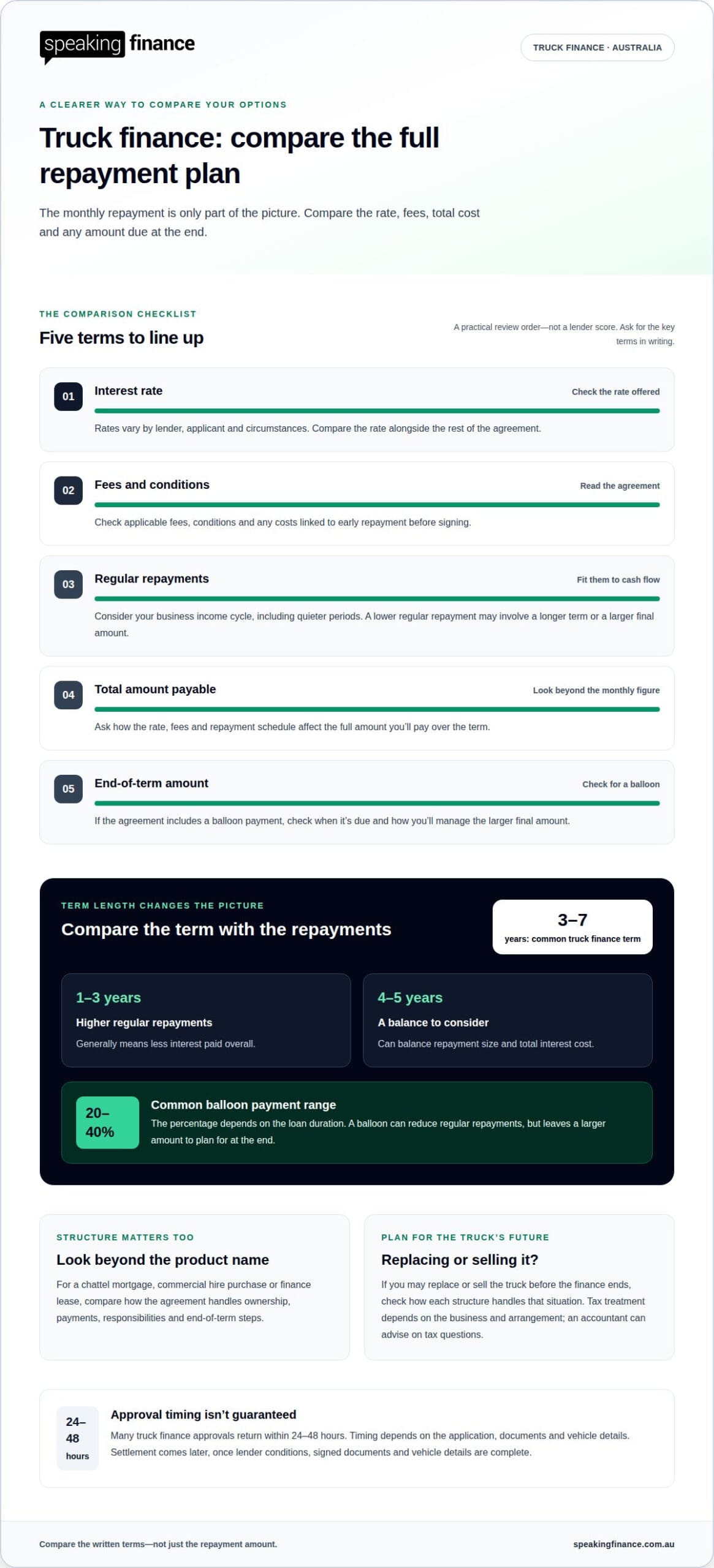
Compare a chattel mortgage, finance lease and other truck loan by looking at the full repayment plan, not just the amount due each month. Truck finance in Australia is commonly structured over 3-7 years. A 1-3 year term generally means higher regular repayments but less interest paid overall, while 4-5 years can balance repayment size and total interest cost. The suitable structure depends on your cash flow and business plans.
Ask the lender to show how the interest rate, fees and repayment schedule affect the total amount payable. A lower regular payment may come with a longer term or a larger amount due at the end. Compare the timing and size of payments with your business income cycle. For example, a seasonal operator may want to consider whether scheduled payments remain manageable during quieter periods.
Some agreements include a balloon payment, which is a larger final amount. Truck finance balloon payments commonly range from 20-40%, depending on loan duration. Check whether the agreement includes one, when it falls due and how it changes the total cost. A balloon can reduce regular repayments, but it leaves a larger amount to plan for at the end of the term.
Before choosing a chattel mortgage, lease or loan, request the key terms in writing and compare the same truck purchase across available structures. Focus on the interest rate, fees, regular repayments, total payable and any end-of-term amount. If your business expects to replace the truck before the finance ends, understand the agreement’s process for doing so. A clear comparison connects the finance structure to how your business plans to use the vehicle.
Pre-approval process and settlement timing
Approval timeframes vary between lenders and applications. Timing depends on the supporting documents, vehicle details and any further information required. Settlement is a separate step and occurs after the lender’s conditions and documentation requirements have been met.
Pre-approval steps
Pre-approval starts with an application outlining the truck, requested amount, business and proposed loan term. The lender assesses the applicant’s financial position, credit history and supporting documents. For an Australian business, these may include records showing income and existing commitments. The lender then provides an indication of the amount and terms it may consider. Treat this as a guide for planning, not final approval: the chosen truck and completed application still need assessment.
Approval times and credit checks
Approval timing depends on the lender, the application and whether the required information is complete. An approval does not mean settlement has occurred. A credit check forms part of the lender’s assessment, alongside income evidence, liabilities and the requested finance amount. Different lenders have different credit policies and documentation requirements. A missing document or a change to the truck, amount or loan term can mean the lender needs more information before completing its assessment.
Settlement timing
After approval, the lender confirms any remaining conditions and prepares the finance documents. You review and sign them, while the seller supplies the details needed to complete the vehicle purchase. For example, a delay in receiving a sale invoice or correcting truck details can hold up settlement. The lender must also meet its requirements before releasing funds. Keep the purchase amount and vehicle information consistent across the application and sale documents to reduce avoidable back-and-forth.
Before accepting an offer, compare the interest rate, fees, monthly repayments and total cost over the loan term. A competitive rate alone doesn’t show whether the repayments suit your business cash flow. Check that the approved amount still matches the truck purchase and your plans before moving to settlement.
Speaking Finance: Truck Finance
Speaking Finance helps Melbourne buyers explore truck finance options through its network of more than 70 lenders. As a finance brokerage, it can help you understand and compare potentially suitable options, since lenders assess applications differently and may have different documentation requirements.
A broker may be useful if you’re weighing a chattel mortgage against a lease, buying a truck for your business, or applying with a less straightforward income or credit history. The right structure depends on your circumstances, the vehicle and how repayments fit your plans. Speaking Finance also helps with Car Finance, Business Loans and Personal Loans when those needs are relevant.
Talk to Speaking Finance about your truck finance options.
Plan your next move with confidence
Before committing to a truck, map out how it will fit your work and cash flow. Consider the job it needs to do, the finance structure you’re comfortable with and the repayments your business can manage alongside running costs. For truck finance in Melbourne, Speaking Finance can help you understand options across lenders and the information needed to assess your application.
Speaking Finance arranges truck finance and can help you consider options suited to your circumstances. If your borrowing needs extend beyond the vehicle, it also offers Car Finance, Business Loans and Personal Loans. These address different needs, so the right option depends on what you want to fund.
When you’re ready, speak with Speaking Finance about your situation and work through the available finance options.
A clear plan can make the road ahead feel more manageable.
Frequently Asked Questions
What Are the Available Truck Financing Options?
Common options include a chattel mortgage, commercial hire purchase, finance lease and other truck loans. The structure to explore depends on who should own the vehicle during the agreement, how your business wants to manage payments and what happens at the end. For example, if retaining ownership matters, compare that priority with each lender’s agreement terms before choosing a structure.
How does the loan term affect my truck finance repayments?
A longer loan term usually spreads the amount borrowed across more payments, which can lower each regular repayment but increase the time interest accrues. A shorter term means larger regular payments, so check they fit alongside fuel, maintenance and other business costs. Compare the total amount payable, not just the repayment amount, and check whether a balloon payment changes what’s due at the end.
How much can I borrow for a truck?
The amount a lender may offer depends on your financial position, the truck’s value, your deposit or trade-in and the lender’s assessment. For example, an established business with clear financial records may present a different application from a new operator. The purchase price alone doesn’t determine borrowing capacity. Include existing debts and the repayments your business can manage when discussing an amount.
How does a broker help you confirm whether to provide the truck price including or excluding GST?
A broker can clarify what the seller’s quote shows and how the lender wants the purchase amount presented in the application. Matching the figures across the quote and finance request can reduce confusion if one document includes GST and another separates it. For GST treatment or claims, speak with your accountant. This keeps finance paperwork and tax advice in their proper lanes.
How does a broker account for your trade-in when assessing the deposit for truck finance?
A broker can include trade-in details in the finance request and explain how the lender will assess the contribution. The key figures are the agreed trade-in value and any finance still owing on that vehicle. For example, an outstanding payout may reduce the equity available towards the next truck. The lender’s treatment of the trade-in can affect the amount requested and the overall application.
What truck finance options are available in Melbourne?
For truck finance in Melbourne, buyers can explore commercial finance structures such as a chattel mortgage, commercial hire purchase, finance lease or another truck loan. Available options depend on the lender, applicant and vehicle. Speaking Finance can help present your circumstances to lenders and explain differences in their requirements. The truck’s intended business use and your preferred ownership arrangement can help shape the discussion.

Article by
Steven Emms
Steven Emms is the Director of Speaking Finance, an Australian finance brokerage based in Melbourne, Victoria.
Steven and his team help consumers, sole traders and businesses navigate vehicle finance, equipment finance, business lending, working capital and personal finance. His approach is simple: explain finance in plain English, cut through unnecessary jargon and help clients make informed decisions.
At Speaking Finance, the philosophy is simple: **We make finance black and white.**
Outside of finance, Steven is a long-suffering Essendon supporter, which has given him plenty of practice managing expectations and dealing with disappointment.
Disclaimer
The information in this article is general in nature and is provided for educational purposes only. It does not take into account your personal circumstances, financial situation, needs or objectives and should not be relied upon as personalised financial or credit advice.
Speaking Finance is a finance brokerage, not a direct lender. Finance products, interest rates, fees, terms and eligibility criteria vary between lenders and are subject to individual assessment, applicable lending policies and approval. No finance approval or particular outcome is guaranteed.
Information is believed to be accurate at the time of publication but may change. Before making financial decisions, consider your circumstances and seek appropriate independent professional advice where necessary.