Could one repayment make business finances simpler but leave you with a bigger commitment overall? A business debt consolidation loan can bring several debts into one facility, but fewer due dates do not automatically mean lower total borrowing costs or a better fit for your business.
Juggling repayments, balances and deadlines can take time away from running your business. It’s reasonable to want a clearer arrangement, while also considering what a new loan could cost and whether your business meets a lender’s requirements.
This article explains what consolidation changes and how to compare a proposed facility with your existing debts. You’ll look at repayments, loan term, interest, fees and security requirements, as well as the information that may help when exploring options. Lenders assess applications differently and decide approval, pricing and final terms. The aim is to help you weigh the trade-offs, not assume that combining debts will save money.
Key Takeaways
- A business debt consolidation loan may replace several debts with one facility, but the lender’s terms determine what actually changes.
- Compare a term loan with an overdraft or line of credit by considering how each structure fits your business’s borrowing needs.
- Set out current and proposed balances, repayment amounts and frequency, remaining terms, disclosed fees and total amount payable side by side.
- A broker can help organise lender pathways and documentation, while the lender assesses the application and sets the final terms.
What a business debt consolidation loan changes, and what it does not
A business debt consolidation loan is a new facility that may be used to repay several existing business debts, bringing them under one set of loan terms. Which debts can be included depends on the lender, the business and the proposed structure. The lender decides whether to approve an application and sets the pricing and final terms.
The appeal is often practical: fewer repayments and due dates can make cash flow administration easier. But combining debts does not erase what’s owed, and a simpler repayment schedule does not automatically reduce the total cost. One repayment can simplify the process, but only the full loan terms show whether the change suits your business or costs less overall. For a general overview, see What is debt consolidation?
Which business debts might a business consider consolidating?
Start by reviewing your existing business facilities, their balances, repayment arrangements and purposes. A lender may not include every debt in a proposed facility, so do not assume all borrowing can be combined. Purpose and structure matter: business borrowing is assessed differently from personal lending, and a debt taken out personally does not automatically become a business debt because it helped pay for business expenses. A broker can help explain how business loan options may fit the discussion.
Does one repayment mean the business pays less overall?
Not necessarily. A new facility may have a different interest rate, repayment frequency or term, which is the time allowed to repay it. Extending repayments over a longer term could lower each scheduled payment while increasing the total amount paid over the life of the loan. A shorter term may mean larger repayments, even if the overall cost differs.
For a fair comparison, look beyond the regular repayment. Check the proposed term, disclosed fees, repayment frequency and total amount payable against the remaining costs of your current facilities. Any saving depends on the actual lender terms and your business circumstances, and is not guaranteed. The useful question is whether the new arrangement balances manageable repayments with a suitable overall cost.
Business debt consolidation loan options and structures to understand
A business debt consolidation loan can be structured in different ways, depending on the debts involved, your business’s needs and what a lender may consider. A term loan provides a set amount to repay under agreed terms. An overdraft or line of credit is a revolving facility: the business can draw funds, repay them and potentially draw again, subject to the facility’s limit and conditions.
Facilities can serve a similar purpose but have different lender terms, repayment rules and conditions. Compare the structure, not just the label. The overview How Business Debt Consolidation Loans Work also discusses factors and trade-offs to consider.
How can refinancing differ from consolidating several debts?
Refinancing means replacing or changing an existing finance arrangement. Consolidation focuses on bringing multiple debts together under a new facility. The ideas can overlap: a business might refinance one loan or seek a new facility intended to repay several debts. Lenders may use these terms differently, so focus on what the proposed facility will repay, its purpose and its conditions rather than relying on the name alone.
When might a revolving facility enter the discussion?
A term loan is generally set up for a defined borrowing amount with scheduled repayments over an agreed term. An overdraft or line of credit can provide access to funds as needed, with interest and repayment arrangements set by the lender. That flexibility may suit changing cash needs, but a revolving facility is not automatically suitable for replacing longer-term debts. Compare business finance options by how funds are accessed and repaid, as well as by their overall terms.
Different lenders have different credit policies and documentation requirements, and not every structure suits every business. Speaking Finance can help explain potentially suitable pathways. The lender assesses the application and sets the final terms.
How to compare a business debt consolidation loan with current debts
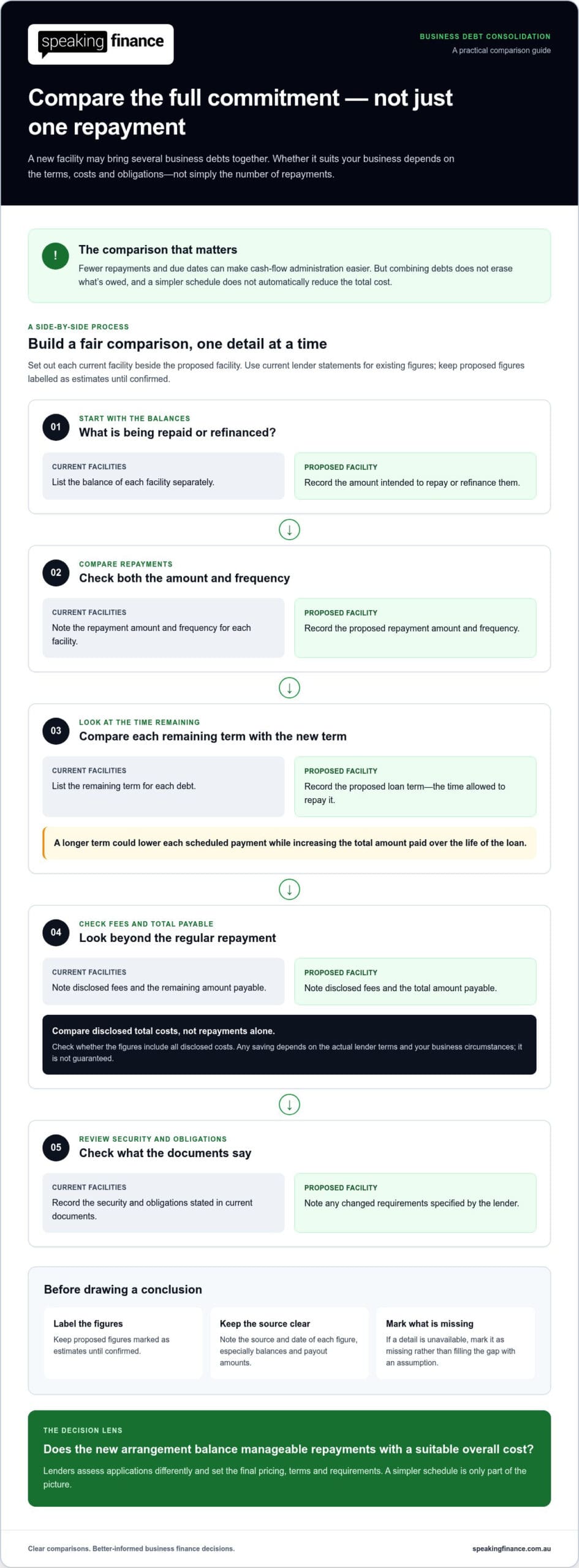
Place your existing facilities beside the proposed loan to see how the details compare. A side by side view can help you spot differences in repayment timing, remaining obligations and information you still need before making a fair assessment.
What should the comparison table include?
Use current lender statements for existing figures and label proposed figures as estimates until confirmed. Note the source and date of each figure, especially balances and payout amounts, which can change. If a detail is missing, mark it as missing rather than filling the gap with an assumption.
| Compare | Current facilities | Proposed facility |
|---|---|---|
| Balance | List each facility separately | Amount intended to repay or refinance them |
| Repayment | Amount and frequency for each facility | Proposed amount and frequency |
| Time remaining | Remaining term for each debt | Proposed loan term |
| Fees and total payable | Disclosed fees and remaining amount payable | Disclosed fees and total amount payable |
| Security and obligations | Details stated in current documents | Any changed requirements specified by the lender |
Compare disclosed total costs, not repayments alone. A smaller scheduled payment may reflect a longer repayment period. Check the amount payable across the full term and note whether figures include all disclosed costs. If a figure or term is unclear, get it clarified before treating the comparison as complete.
How can the business test whether the structure fits?
Map the proposed repayment dates against the business’s cash flow cycle, including when customer payments usually arrive and when major expenses fall due. This will not guarantee improved cash flow, but it can help reveal timing pressure. For related business finance services, consider how other commercial finance pathways may fit alongside the proposal. Discuss possible accounting or tax implications with your accountant or another suitably qualified professional.
What to expect when discussing business debt consolidation with a broker
A broker can help organise the steps involved in exploring a business debt consolidation loan, explain potential lender pathways and keep you informed as the application progresses. Speaking Finance is a finance broker, not a lender. The lender assesses the application and decides whether to approve it, along with the pricing and final terms.
The process generally moves through these stages:
- Understand your purpose and circumstances: Discuss what you want to achieve, the debts involved and your business’s objectives.
- Identify potential pathways: Consider finance structures and lenders that may suit your circumstances. Lender policies and appetite differ.
- Explain the requirements: Go through key lender requirements and differences in plain English.
- Organise the information: Collect and arrange the business and finance details needed for an application.
- Present the application: Submit it to an appropriate lender or lenders for assessment.
- Manage communication: Help you work through lender questions and requests for further documents during the approval process.
- Support documentation and settlement: Assist through documentation and settlement, and provide post-settlement support where relevant.
What information may help start the discussion?
A list of business debts gives the discussion a practical starting point. Where available, gather recent statements, current balances, repayment amounts and frequency, and details of existing loan terms. You do not need to guess missing figures. The information required can vary with the lender, proposed facility and your circumstances, so the initial list may be refined as options are explored.
How does Speaking Finance support the process?
Speaking Finance helps businesses explore debt consolidation finance, explain finance terms in plain English, organise application information and clarify lender questions as they arise. Different lenders may ask for different documents or assess a business differently, so follow-up may be needed. Speaking Finance can support communication through to settlement and, where relevant, after settlement. Approval, pricing and timing are not guaranteed; those decisions sit with the lender.
Take a clear next step for your business
Before exploring a business debt consolidation loan, decide what you want the new arrangement to achieve. Is the priority to simplify administration, adjust repayment timing or review existing finance? A clear goal gives you a practical way to assess whether a proposed structure fits, without assuming consolidation will improve cash flow or reduce costs.
Speaking Finance works with a broad panel of lenders, whose requirements and appetites can differ. That can help when considering pathways that may suit your circumstances. Speaking Finance can also explain proposed finance terms in plain English, so you can weigh them against your business’s needs.
A conversation can help clarify what you are looking for and what information may be useful when exploring options. Take the time you need to weigh a proposal against your business’s plans and priorities.
Frequently Asked Questions
What is a business debt consolidation loan?
It is business borrowing intended to pay out selected existing business debts. Before proceeding, clarify which accounts the proposed facility is meant to clear and how any balance not covered will be handled. Payout figures can change, so compare the amounts being used with current lender information and the final settlement details.
Can a business debt consolidation loan reduce monthly repayments?
Possibly, but check whether the proposed payment schedule lines up with when the business receives income, not just whether the monthly amount looks manageable. Review the payment dates and how repayments are calculated under the proposed terms. Testing the schedule against quieter trading periods and regular obligations can help show whether it looks workable.
Is business debt consolidation suitable for every business?
No. If the business regularly lacks enough income to cover its ongoing costs, combining debts may rearrange obligations without fixing the underlying shortfall. Identify what is driving the cash pressure and consider whether changing existing borrowing addresses that issue. A lender assesses the business’s circumstances before deciding whether to offer a facility.
What documents might a lender request for business debt consolidation?
Depending on the application, a lender may request business activity statements, tax returns or cash flow forecasts alongside other financial records. Requirements vary, so treat these as possible examples rather than a standard checklist. Keeping documents current and clearly labelled can make it easier to respond to follow-up requests. The broker can help explain what information is needed for the application.
Can tax debt be included in a business debt consolidation loan?
An ATO liability may be considered, subject to the lender’s assessment and proposed terms. Be clear whether the tax debt belongs to the business or an individual, and have the current account position and any payment arrangement details available for discussion. If refinancing the debt may affect the business’s tax position, ask your accountant about the implications before making a decision.

Article by
Steven Emms
Steven Emms is the Director of Speaking Finance, an Australian finance brokerage based in Melbourne, Victoria.
Steven and his team help consumers, sole traders and businesses navigate vehicle finance, equipment finance, business lending, working capital and personal finance. His approach is simple: explain finance in plain English, cut through unnecessary jargon and help clients make informed decisions.
At Speaking Finance, the philosophy is simple: **We make finance black and white.**
Outside of finance, Steven is a long-suffering Essendon supporter, which has given him plenty of practice managing expectations and dealing with disappointment.
Disclaimer
The information in this article is general in nature and is provided for educational purposes only. It does not take into account your personal circumstances, financial situation, needs or objectives and should not be relied upon as personalised financial or credit advice.
Speaking Finance is a finance brokerage, not a direct lender. Finance products, interest rates, fees, terms and eligibility criteria vary between lenders and are subject to individual assessment, applicable lending policies and approval. No finance approval or particular outcome is guaranteed.
Information is believed to be accurate at the time of publication but may change. Before making financial decisions, consider your circumstances and seek appropriate independent professional advice where necessary.