A lower repayment can leave a bigger decision for later. A commercial vehicle finance calculator estimates repayments from the amount borrowed, interest rate, loan term and repayment frequency you enter. If you include a balloon, the regular repayments may be lower, but a final lump sum remains owing. For example, a 30% balloon on a A$100,000 truck loan leaves A$30,000 to pay at the end of the term.
It makes sense to focus on the repayments your business can manage each week or month. But the interest rate is only one part of the comparison: the loan term, fees, repayment frequency and balloon payment all affect the overall cost, and lender rates and terms vary. This guide explains how to use a commercial vehicle finance calculator, what to enter and how to compare estimates on a like-for-like basis. You’ll also learn how balloon payments work, what can change a final offer and when a broker can help you compare potentially suitable business vehicle finance options.
Key Takeaways
- Use the calculator to explore equipment finance repayments too, then allow for fees, charges and your circumstances when interpreting the estimate.
- A balloon can reduce regular repayments, but leaves a lump sum to plan for at the end of the loan.
- Compare weekly, fortnightly and monthly repayments against your cash flow, and keep the repayment frequency consistent when comparing options.
- Look beyond the interest rate: compare the loan term, fees and repayment structure, as lenders’ rates and requirements can vary.
Can I use this calculator for equipment finance as well?
Yes. You can use a commercial vehicle finance calculator to estimate repayments for equipment finance, too. Enter the amount borrowed, the relevant interest rate, the loan term and repayment frequency. When comparing estimates for a vehicle or equipment, keep these inputs consistent. Sole traders can follow the same steps to get an initial repayment estimate.
The result is a guide, not a personalised quote. It won’t account for your credit position, business circumstances, lender charges or every detail of the finance structure. A chattel mortgage, for example, has its own terms and obligations. The lender assesses your application and documents before making an offer, so the actual repayment may differ from the calculator estimate. Use the figure to plan and compare, not as a confirmed amount.
Calculator estimates don’t include lender fees and charges or account for GST and tax deductions. Can Australian businesses claim GST and tax deductions on commercial vehicle finance? A calculator can’t determine that. GST treatment and deductions depend on the business and finance arrangement. Ask your accountant how GST and tax rules apply to your circumstances before relying on them in your budget.
What eligibility requirements do Australian lenders have for commercial vehicle finance? Lenders assess factors such as credit history, business income and cash flow, time trading, the asset being financed and the application documents. Requirements differ between lenders, so a calculator result alone can’t show whether an application meets a lender’s criteria.
What risks should businesses consider when financing a commercial vehicle? Check that repayments fit your cash flow, understand all charges and plan for any final balloon payment. The finance agreement creates an obligation to repay, even if the vehicle is temporarily off the road or business income changes. Compare the full terms, not just the regular repayment, before committing.
What are Balloon Payments?
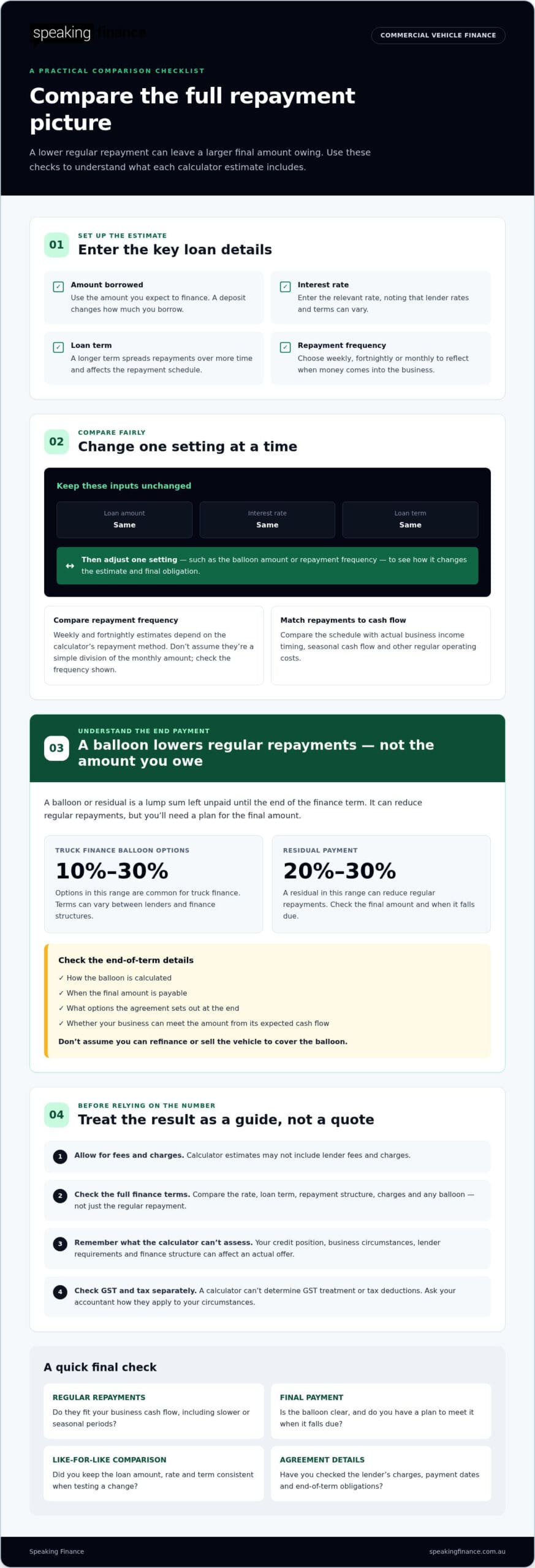
A balloon payment leaves part of the loan unpaid until the end of the term. It can lower regular repayments, but you’ll need a plan for the final amount.
Balloon and Residual Payments
“Balloon” and “residual” describe a lump sum due at the end of finance. For truck finance, balloon options of 10% to 30% are common, and a residual payment of 20% to 30% can reduce regular repayments. The terms can vary between lenders and finance structures. Check the final amount, when it falls due and how you expect to pay it.
Adjusting Loan Terms and Balloon Amounts
The loan term, interest rate and balloon amount all affect repayments. A longer term spreads repayments over more time, while a larger balloon leaves more to pay at the end. Enter the same loan amount and interest rate when comparing scenarios, then adjust one setting at a time. This shows how each change affects regular repayments and the final obligation.
Compare the full repayment picture, not just the amount due each month. For example, consider whether your business’s seasonal cash flow can manage regular payments and whether it can meet the final lump sum. A deposit changes how much you borrow, while the rate and term affect the repayment schedule. Check that the estimated structure fits the vehicle’s expected role in your business.
Review the finance terms, including charges and other loan features, alongside the balloon payment. A lower regular repayment doesn’t remove the final payment or your obligation to meet it. Check whether the agreement explains how the balloon is calculated, when it’s payable and what options apply at the end. Don’t assume you can refinance or sell the vehicle to cover it.
If you’re weighing up different structures, get help comparing finance options and their repayment terms.
Weekly, fortnightly and monthly repayment frequencies
Choose a repayment frequency that fits when money comes into your business. Then compare the estimate with your actual cash flow, not just the repayment amount shown.
For a fair comparison, keep the loan amount, interest rate and term unchanged, and change only the repayment frequency. Weekly and fortnightly figures depend on the calculator’s repayment method, so don’t assume they equal a simple division of the monthly amount. Check the frequency stated in the estimate.
What are the differences between a chattel mortgage, finance lease and operating lease? With a chattel mortgage, the business owns the vehicle while the lender holds security over it. Under a finance lease, the financier owns the vehicle during the lease. An operating lease generally covers its use, with the vehicle returned at the end. The agreement sets out the payments and end-of-term obligations.
For a chattel mortgage, check whether the repayment schedule includes a balloon payment. That final amount sits alongside regular repayments, so compare the full schedule rather than looking only at weekly or monthly costs. A calculator can show how changing the repayment frequency affects the estimate, but the finance agreement determines the actual payment dates and amounts.
Extra repayments can reduce the balance faster, but access to additional payments or redraw depends on the loan terms. Before relying on redraw, check whether it’s available and how its conditions work. The same applies when business income varies: a repayment schedule that suits a strong month can feel tight during a slower one.
Match repayment dates to income. If customers usually pay invoices fortnightly, compare a fortnightly schedule with monthly repayments against that timing. Include other regular business commitments in your cash-flow plan, then assess whether each option leaves enough room for operating costs. A broker can help compare finance structures and interest rates, while the lender’s contract confirms the repayment terms.
Comparing commercial vehicle finance rates
Compare more than the advertised interest rate. For Australian truck finance, rates are stated to typically range from 5% to 12%, but the rate offered depends on the lender, applicant and circumstances. A lower rate alone doesn’t show the full cost or whether the loan structure suits your business.
Start by comparing like with like. Use the same loan amount, loan term, repayment frequency and balloon setting in each repayment calculator. A comparison-rate example uses a A$30,000 loan over five years, with monthly principal-and-interest repayments at a fixed rate. That common basis makes the figures easier to assess side by side.
Next, compare the total payable and the terms behind each estimate. Check the interest, lender charges, any balloon payment and whether repayments are monthly or fortnightly. A different frequency can change the amount and timing of cash leaving your account. Read the offer documents to see which charges apply and when they’re payable.
Rates can also reflect the asset, application and lender’s credit assessment. Vehicle type, age, business details and supporting documents may affect which options are considered. Lenders have different credit policies and documentation requirements, so an estimate from one calculator won’t predict another lender’s decision. Compare the structure and conditions, not just the headline rate.
Before choosing, work through the figures in sequence: match the loan settings, review the repayments and total cost, then check charges and end-of-term obligations. Consider how a changed rate or loan term affects repayments, and whether a balloon leaves a final amount due. A broker can help compare potentially suitable options across lenders, while the lender’s offer sets out the final terms.
Speaking Finance: Car Finance
Speaking Finance can help you turn a repayment estimate into practical questions about a potential finance offer. Consider how the proposed terms fit the vehicle’s role in your business and your plans for its future use.
Different lenders assess applications in different ways. A broker can help you understand available options and compare the terms that matter to your decision.
If you’re ready to discuss your next step, contact Speaking Finance for guidance.
Make your next finance decision with clarity
Start by deciding what the vehicle needs to do for your business and what repayment commitment fits alongside its running costs. A commercial vehicle finance calculator can help you frame your budget, but the next step is to weigh that budget against the finance structure and documents an application may require.
Speaking Finance can help you understand and compare potentially suitable options from its lender panel. Depending on whether the borrowing is for business or personal use, Car Finance, Business Loans or Personal Loans may be relevant. The right fit depends on the vehicle’s use, your circumstances and the lender’s criteria.
Treat the estimate as a starting point, then consider how a proposed loan fits your broader plans. If you’d like support with the next step, speak with Speaking Finance.
A clearer plan can make the decision feel more manageable.
Frequently Asked Questions
How much can I borrow with a commercial loan?
Work out the vehicle cost your business needs to fund, then consider the contribution you can make and your business’s capacity to meet repayments. Lenders assess each application on its own details, including the asset and the applicant’s financial position.
Does this calculator work for different truck configurations?
A calculator can help estimate finance for different configurations, such as a tipper, refrigerated truck or curtainsider. It uses the finance figures you enter rather than assessing the truck’s build or suitability. Use the purchase details for each vehicle separately. A lender may consider the specific asset, its age and its intended business use as part of its assessment.
How does a commercial vehicle finance calculator work in Australia?
A calculator produces an indicative repayment figure from the finance settings you enter. If you use a balloon option, enter the full credit amount required, not the loan amount after subtracting the balloon. Treat the result as a budgeting tool. The actual finance offer sets out the lender’s terms and any applicable charges.
What information do I need to calculate commercial vehicle finance repayments?
Have the vehicle quote and your planned contribution ready, then identify the finance structure you want to explore. Check whether any costs will be paid separately or included in the amount financed, as this changes the figure you enter. If comparing vehicles, use each vehicle’s own quote rather than relying on a broad budget estimate.
What are the current interest rates for commercial vehicle finance in Australia?
There isn’t one rate that applies to every Australian business vehicle loan. The rate depends on the lender, applicant, asset and finance structure. When reviewing an offer, distinguish the quoted interest rate from the full cost of borrowing, and read the offer documents for charges and conditions. A calculator can compare scenarios, but it can’t show a lender’s current offer for your application.
How do loan term, deposit and balloon payment affect commercial vehicle repayments?
Consider how long you expect to keep the vehicle before choosing a loan term. A vehicle you plan to replace sooner may call for a different structure from one intended for long-term use. Your deposit changes the amount financed, while a balloon leaves a final sum to plan for. Compare options against your vehicle replacement plans and business budget.

Article by
Steven Emms
Steven Emms is the Director of Speaking Finance, an Australian finance brokerage based in Melbourne, Victoria.
Steven and his team help consumers, sole traders and businesses navigate vehicle finance, equipment finance, business lending, working capital and personal finance. His approach is simple: explain finance in plain English, cut through unnecessary jargon and help clients make informed decisions.
At Speaking Finance, the philosophy is simple: **We make finance black and white.**
Outside of finance, Steven is a long-suffering Essendon supporter, which has given him plenty of practice managing expectations and dealing with disappointment.
Disclaimer
The information in this article is general in nature and is provided for educational purposes only. It does not take into account your personal circumstances, financial situation, needs or objectives and should not be relied upon as personalised financial or credit advice.
Speaking Finance is a finance brokerage, not a direct lender. Finance products, interest rates, fees, terms and eligibility criteria vary between lenders and are subject to individual assessment, applicable lending policies and approval. No finance approval or particular outcome is guaranteed.
Information is believed to be accurate at the time of publication but may change. Before making financial decisions, consider your circumstances and seek appropriate independent professional advice where necessary.