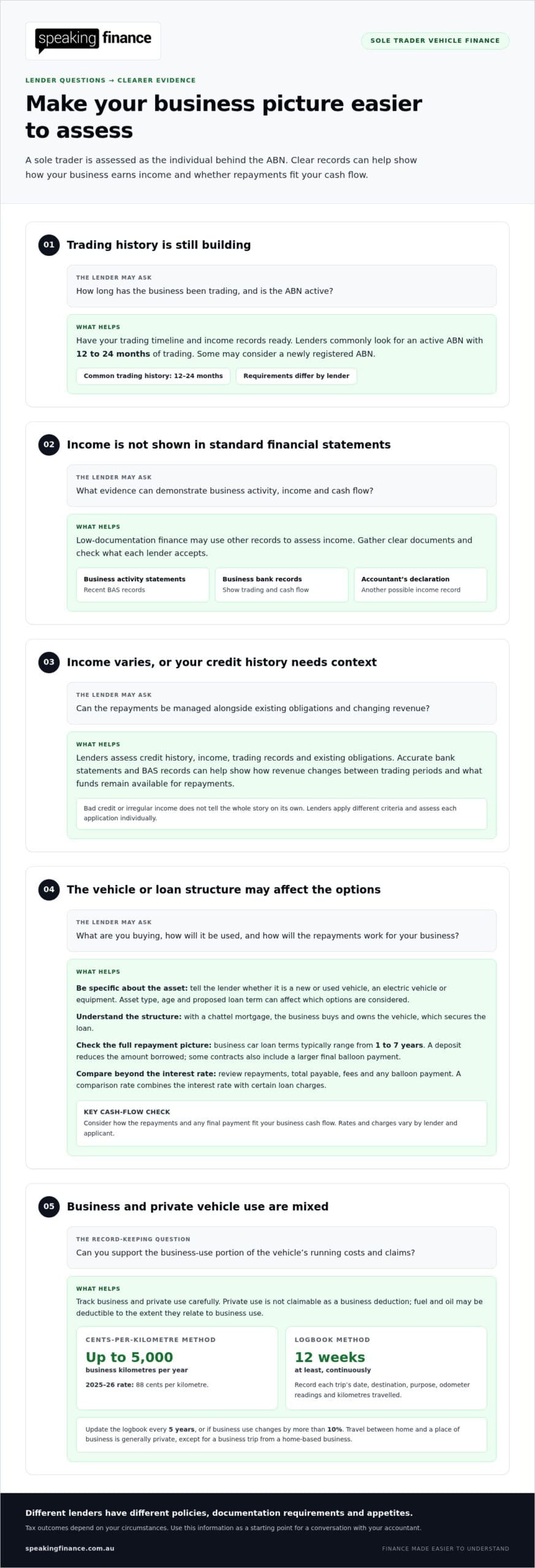
An ABN alone doesn’t decide whether a vehicle loan will suit your business. Sole trader vehicle finance is assessed against you as the individual behind the ABN, with lenders weighing your income and trading history against the repayments. A chattel mortgage is one common business option: you buy and own the vehicle, which secures the loan. Lenders commonly look for an active ABN with 12 to 24 months of trading, though their policies differ.
It’s understandable to focus on the interest rate, but the loan structure and your financial position matter too. Clear records can show how your business earns income and whether repayments are manageable within your cash flow.
This guide explains how business car loans work, what lenders may consider, and how business use can relate to tax deductions, depreciation and GST credits. It also covers why private use matters and what to consider before choosing a loan structure. Tax outcomes depend on your circumstances, so use this information as a starting point for a conversation with your accountant.
Key Takeaways
- Compare the loan structure with how you’ll use and own the vehicle, not just the advertised rate.
- Prepare clear records of your income and trading history to help lenders assess your application.
- Check how repayments, loan terms and any final balloon payment could affect your business cash flow.
- Track business and private vehicle use carefully, as it can affect deductions, depreciation and GST claims.
Does your structure really change a vehicle finance approval?
Your business structure affects who applies, but it doesn’t automatically make approval easier. Lenders consider whether the income supporting the application can cover the vehicle repayments.
Business structure and finance assessment
With sole trader vehicle finance, the borrower is assessed as the individual operating under the ABN. A company is assessed separately, and its director is usually expected to provide a personal guarantee. Neither structure automatically makes approval easier. Lenders assess whether income supports the repayments, along with the applicant’s circumstances and existing obligations.
A chattel mortgage lets a business buy and own a vehicle, with the vehicle serving as security for the loan. GST registration may affect which lenders consider an application, but it doesn’t determine the interest rate. Compare the purchase structure with how you’ll use the vehicle and manage repayments.
A start-up may have less trading history to show than an established business. Lenders commonly look for an active ABN with 12 to 24 months of trading, while some may consider a newly registered ABN. Organise income records and business financial information to show your situation clearly. If buying a vehicle and work equipment, consider each asset and its funding needs separately.
Business-use records and logbooks
Keep records showing how much the vehicle is used for business. If it has mixed business and private use, identify and support the business-use percentage. Private use isn’t claimable as a business deduction. Fuel and oil costs may be deductible to the extent they relate to business use. Travel between home and a place of business is generally private, except for a business trip from a home-based business.
For the cents-per-kilometre method, sole traders can claim up to 5,000 business kilometres per year. The 2025-26 rate is 88 cents per kilometre. Under the logbook method, keep a logbook for at least 12 continuous weeks. Record each trip’s date, destination, purpose, odometer readings and kilometres travelled. Update it every 5 years, or if business use changes by more than 10%.
Sole trader eligibility
Eligibility depends on factors such as your income, trading records, credit history and the vehicle or equipment you want to finance. Lenders use different criteria, so the documents and requirements for one application may differ from another’s.
Low-documentation finance eligibility
Low-documentation finance may suit self-employed applicants who don’t have traditional financial statements ready. Instead, lenders may accept recent business activity statements, business bank records or an accountant’s declaration to assess income. These documents help show trading activity and cash flow. Before applying, gather clear records of your income and compare the evidence required by each lender.
Eligibility checks may include being at least 18, trading for over 12 months and having an ABN registered for at least two years. These are possible requirements, not a single rule for every lender. New businesses can also find that some lenders consider a newly registered ABN, depending on the application and supporting information.
Lenders’ vehicle and equipment policies differ. Explain whether you’re buying a new or used vehicle, an electric vehicle or equipment, and how you’ll use it for business. The asset type, age and proposed loan term can affect which options lenders consider. Before choosing a structure, assess how the repayments would fit your cash flow.
For 2025-26, the announced instant asset write-off threshold was A$20,000 for eligible assets, for sole traders and small businesses with turnover under A$10 million. The Australian Government announced an extension on 4 April 2025; as of October 2025, Parliament had not passed the legislation. Ask your accountant how the rules apply to your purchase and circumstances.
Bad credit and irregular income
Can sole traders get vehicle finance with bad credit or irregular income? You can apply, but lenders assess credit history alongside income, trading records and existing obligations. Records showing how revenue changes between trading periods, and what funds remain available for repayments, can help explain irregular earnings. Accurate bank statements and business activity statements may also help show the pattern.
If you’re weighing up a vehicle purchase, talk through your finance options.
What is a business car loan?
How does vehicle finance work for sole traders in Australia? A business car loan funds a vehicle purchase, and the vehicle commonly secures the borrowing. You repay the amount over an agreed term, with interest and any final balloon payment set out in the contract.
Loan amounts and terms
Business car loan terms typically range from one to seven years. The loan amount and term determine the repayment schedule, so consider what fits your cash flow before buying. A longer term spreads repayments over more time, but the contract’s total cost matters too.
Loan deposits, security and balloon payments
A deposit reduces the amount you borrow, while a secured loan uses the vehicle as security. With a chattel mortgage, the business buys and owns the vehicle, which secures the loan. Some contracts include a balloon payment, a larger amount due at the end. Check the final payment in the contract and plan how you’ll meet it.
Interest and comparison rates
The interest rate affects borrowing costs, but it isn’t the only figure to compare. A comparison rate combines the interest rate with certain loan charges to indicate the broader cost. Compare repayments, the total payable, fees and any balloon payment across offers. Rates and charges vary by lender and applicant, so review the full contract rather than choosing on rate alone.
Credit history and loan serviceability
Approval depends on the lender’s assessment of your credit history and ability to repay. Before applying, check your credit file for errors and bring bills and debt repayments up to date. Organise business records, including tax returns and financial statements from the last two years where available. For self-employed applicants, records covering the previous 12 to 36 months can help explain income and show how repayments fit existing obligations.
Tax deductions, depreciation and GST claims
Yes. GST-registered businesses can generally claim GST credits on vehicle purchases and eligible running costs, subject to their circumstances. For 2025-26, the car limit is A$69,674, and business-use percentage affects how much you can claim.
Finance-related tax deductions
Interest on a business car loan may be deductible to the extent the vehicle is used for business. The private-use share isn’t a business deduction. For mixed use, apply the business-use percentage supported by your records rather than claiming the entire interest cost.
Loan repayments include both principal and interest, so the full monthly repayment isn’t an interest deduction. A secured loan’s structure doesn’t determine the deductible amount by itself. Keep loan statements with your vehicle-use records, then ask your accountant how the rules apply to your tax return.
Depreciation and GST claims
A business may claim a deduction for a vehicle’s decline in value when it’s used for legitimate business purposes. Depreciation calculations for passenger cars can be limited by the car limit. For 2025-26, the maximum GST credit stated for a business motor vehicle purchase is A$6,334.
GST credits may also apply to eligible running costs, depending on the GST treatment of your business’s supplies. Claims depend on GST registration, the purchase and business use. Keep tax invoices and records of vehicle use. Your accountant can help apply the rules to your business activity statement.
Car limit and business-use percentage
The car limit restricts the cost used to calculate depreciation for passenger vehicles designed to carry less than one tonne and fewer than nine passengers. Vehicles designed to carry one tonne or more, or nine or more passengers, are treated as other vehicles for income tax purposes.
For mixed use, only the business-use share of eligible expenses is claimable. Record trips and keep evidence supporting that percentage. Financing a vehicle doesn’t make private kilometres business use. Confirm your calculation with your accountant before lodging your return.
Speaking Finance: Car Finance
Speaking Finance can help you compare car finance options for a vehicle used in your business. As a finance brokerage, it connects borrowers with more than 70 lenders, whose policies and documentation requirements can differ.
A finance broker can explain potential finance pathways and their terms. Speaking Finance also arranges Business Loans for funding needs beyond a vehicle.
Before comparing options, consider how the vehicle will support your work and what you want the finance to achieve. Keep tax questions separate and discuss the vehicle’s tax treatment with your accountant.
Make your next vehicle decision with clarity
With sole trader vehicle finance, focus on an option that fits your work and business plans, not just the headline rate. Being clear about what you need from the vehicle can help make your next steps practical.
Speaking Finance can talk through your circumstances and explain potential finance pathways in plain English.
Take the next step when you’re ready. A little clarity now can make the decision feel more manageable.
Frequently Asked Questions
How does buying a car for business affect GST?
A GST-registered business may be able to claim a GST credit on a vehicle purchase and eligible running costs. The credit depends on the GST treatment of the business’s supplies and the vehicle’s business use. Keep the tax invoice and purchase records, and separate private use from business use. Your accountant can help determine how to report the claim in your business activity statement.
Is it easier to finance a vehicle through a company?
No business structure automatically makes vehicle finance approval easier. A company is a separate borrowing entity, and its director is usually expected to support the borrowing with a personal guarantee. A sole trader applies as the individual operating under the ABN. Compare who would be responsible for repayments under each setup, then consider the income and records available to support the application.
What types of vehicle finance can sole traders get in Australia?
Sole traders may be able to apply for a chattel mortgage or finance lease, depending on lender criteria and the vehicle. With a chattel mortgage, the business buys and owns the vehicle, which secures the loan. With a finance lease, the financier owns and leases the vehicle; ownership may transfer at the end if contractual obligations are met. Compare ownership, end-of-term obligations and intended use.
What are the eligibility requirements for sole trader vehicle finance?
Requirements depend on the lender, but an application may be assessed against your age, ABN, trading history, income and credit position. Some lenders may look for an ABN active for 12 to 24 months, while others may consider a newly registered ABN. A clear explanation of your business activity and the vehicle’s role can help connect your application details to the purchase.
What documents and financial records are needed to apply?
Prepare documents showing your identity, ABN, business income and existing financial commitments. Depending on the lender and application, useful records may include recent business activity statements, business bank account records, an accountant’s declaration, tax returns or financial statements. Keep documents current and make business income and expenses easy to follow. A low-documentation application may use alternative income evidence instead of full financial statements.
What interest rates, fees and deposit amounts apply to sole trader car loans?
Rates, fees and deposit requirements depend on the lender, applicant, vehicle and loan structure. A stronger credit history, clear evidence of income and a suitable asset may affect a lender’s assessment, but they don’t determine a universal rate or deposit. Compare the written offer’s interest rate, fees, repayment schedule and any balloon payment. Check the total payable as well as the monthly amount before choosing.

Article by
Steven Emms
Steven Emms is the Director of Speaking Finance, an Australian finance brokerage based in Melbourne, Victoria.
Steven and his team help consumers, sole traders and businesses navigate vehicle finance, equipment finance, business lending, working capital and personal finance. His approach is simple: explain finance in plain English, cut through unnecessary jargon and help clients make informed decisions.
At Speaking Finance, the philosophy is simple: **We make finance black and white.**
Outside of finance, Steven is a long-suffering Essendon supporter, which has given him plenty of practice managing expectations and dealing with disappointment.
Disclaimer
The information in this article is general in nature and is provided for educational purposes only. It does not take into account your personal circumstances, financial situation, needs or objectives and should not be relied upon as personalised financial or credit advice.
Speaking Finance is a finance brokerage, not a direct lender. Finance products, interest rates, fees, terms and eligibility criteria vary between lenders and are subject to individual assessment, applicable lending policies and approval. No finance approval or particular outcome is guaranteed.
Information is believed to be accurate at the time of publication but may change. Before making financial decisions, consider your circumstances and seek appropriate independent professional advice where necessary.