No property or major equipment to offer as security? That doesn’t automatically rule out business finance. But “unsecured” doesn’t mean obligation-free: a lender may still ask for a personal guarantee and assess your business finances. If you’re considering unsecured business loans Australia, look beyond the lack of asset security and understand the full commitment before applying.
To compare options, check how repayments are structured, how interest is calculated, what fees may apply and whether a guarantee is required. It also helps to understand what information a lender may request. This guide explains the differences between unsecured and secured finance, what to look for in an offer and how to prepare for a lender discussion. A finance broker can help explain potentially suitable options from lenders with different policies and requirements.
Key Takeaways
- Unsecured business loans Australia don’t require a specific business asset as security, but lenders still assess the application.
- Not pledging an asset doesn’t guarantee approval or remove your obligations under a loan.
- Compare the total amount repayable, how interest is calculated and any applicable fees, not just the repayment amount.
- Before applying, organise the business, identity, financial and loan purpose information the lender requests.
Unsecured Business Loans in Australia: How They Work
An unsecured business loan doesn’t require a specific business asset to be pledged as security. That’s the main distinction from secured finance, not an indication that the lender skips its assessment. Lenders consider the business, the reason for borrowing and the information provided. Depending on the product and circumstances, they may also require a personal guarantee.
With unsecured business loans Australia, the borrowing is for a business purpose. That differs from personal or consumer lending, which is assessed in relation to an individual and personal borrowing. The structure, repayment terms and obligations depend on the lender, product and applicant’s circumstances. For a general explanation of the unsecured loan concept, see how it differs from borrowing backed by pledged security.
What can unsecured business finance be used for?
A business might use finance for working capital, to manage a cash flow gap or to cover operating costs while waiting for customer payments. These are examples, not a promise that every lender will accept every purpose. Permitted uses and restrictions vary by lender and product, so explain clearly what the funds are for and check the terms before proceeding. To compare different forms of commercial borrowing, explore the available business loan options.
How is unsecured finance different from secured finance?
Secured finance involves pledging an asset as security under the loan arrangement. With unsecured finance, no specific business asset is pledged in that way. A secured structure may be relevant when funding an identifiable asset, while unsecured borrowing may address another business need. Neither is automatically the better or more affordable choice. Compare the full terms and obligations with the purpose of the borrowing and the business’s expected cash flow.
Does unsecured business finance mean easier approval or fewer obligations?
No. Not pledging a specific business asset doesn’t guarantee approval or remove your responsibilities under a loan. A lender may still assess the business’s circumstances, the purpose of borrowing and the information supplied. Credit policies, documentation requirements, pricing and final terms can differ between lenders and applicants, so unsecured finance isn’t automatically simpler or cheaper.
Before deciding whether to proceed, check the proposed terms for a personal guarantee and any other obligations. Speaking Finance is an Australian finance brokerage that can help explain differences between lender requirements and potential finance pathways. The lender makes the credit decision and sets the final terms.
Could a lender still ask for a personal guarantee?
Yes. A personal guarantee may form part of a business loan offer, depending on the lender and transaction. It can make an individual responsible for certain obligations if the business doesn’t meet them, but its effect depends on the wording and circumstances. Read the guarantee and loan documents carefully. If you’re unsure who could be responsible or what a clause means, ask a suitably qualified solicitor for advice before signing.
What are the trade-offs of borrowing without specific asset security?
One potential advantage is that a particular business asset isn’t pledged as security for the loan. That may matter if you want to keep an asset outside that specific security arrangement. However, unsecured finance can still come with conditions, and a lender may price or structure it differently from a secured option. Compare the full obligations and costs, not only the security requirement. Neither structure suits every business or purpose.
If you’re weighing up unsecured business loans Australia lenders may offer, Speaking Finance can help you understand and compare potentially suitable pathways. See How We Can Help →
How should you compare unsecured business loans before applying?
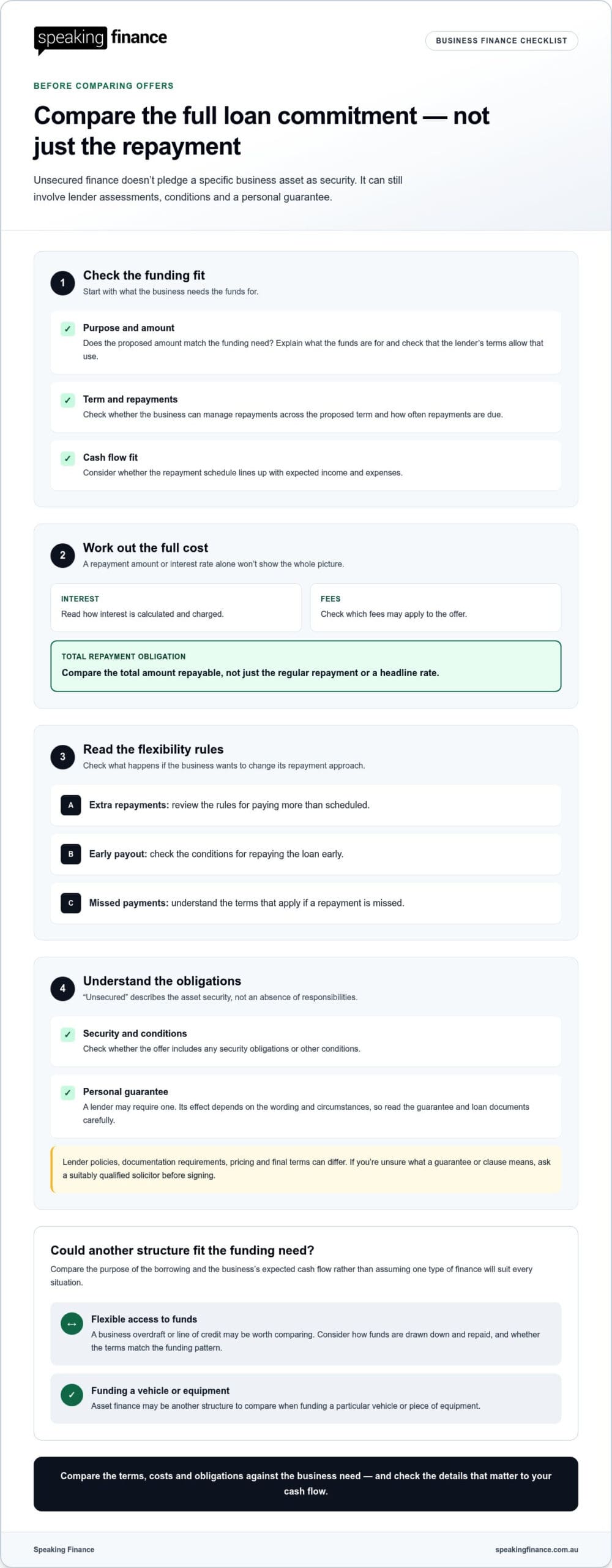
Start with the purpose of the funds. A one off expense and an ongoing cash flow gap may call for different ways of accessing finance. For each option, check how interest is calculated, the total repayment obligation and any applicable fees. Then consider whether the repayment schedule aligns with the business’s expected income and expenses.
Look beyond headline claims. Compare the lender’s documentation requests, conditions and flexibility, including the rules for extra repayments, early payout and missed payments. A rate on its own doesn’t show the full cost or whether a particular structure fits the business’s needs.
Which loan features should a business compare?
| Feature | What to check |
|---|---|
| Amount and term | Does the amount match the funding need, and can the business manage repayments across the proposed term? |
| Repayment schedule | Check the repayment frequency and how it aligns with expected cash coming in. |
| Interest and fees | Read how interest is charged and which fees may apply. |
| Flexibility | Review the rules for extra repayments, early payout and missed payments. |
| Security and conditions | Check any security obligations, guarantees or other offer conditions. |
These details are lender specific. If the business needs flexible access to funds rather than a lump sum, a business overdraft or line of credit may also be worth comparing. Consider how each facility is drawn down and repaid, and whether its terms match the funding pattern.
When might another business finance structure be relevant?
If you’re funding a particular vehicle or piece of equipment, asset finance for vehicle loans may be another structure to compare. The asset, business circumstances and lender terms all matter. Weigh the options against the purchase and cash flow rather than assuming one type of finance will suit every situation.
How can you prepare for an unsecured business loan application?
Begin with a clear picture of what the business needs and how repayments could fit its cash flow. If you’re comparing unsecured business loans in Australia, getting organised can make conversations with lenders more focused. It doesn’t guarantee approval or a particular outcome.
What information may help you prepare?
First, clarify the purpose of the funds, the amount you’re seeking and how the business expects to repay the borrowing. Then organise the information a lender requests. This may include:
- Business details, such as ABN or company information
- Identification for relevant applicants or directors
- Financial records, which may include bank statements, accounts or BAS
- Documents that explain the proposed use of funds
This isn’t a fixed checklist. Requirements differ by lender, applicant and application, so follow the specific requests rather than sending every document you have.
What happens when you work with a finance broker?
A finance broker helps you understand potential pathways and lender requirements. The lender decides whether to approve an application and sets the final terms. The process generally involves:
- Understanding your purpose, circumstances and objectives
- Identifying potentially suitable finance pathways and lenders
- Explaining key requirements and differences in plain English
- Collecting and organising the information required for an application
- Presenting the application to an appropriate lender or lenders
- Managing communication, questions and document requests through the approval process
- Assisting with documentation and settlement, and providing post settlement support where relevant
Different lenders may request different information, and the process depends on your circumstances and the option being considered. You don’t need to have every answer before you start exploring your options.
Make your next finance conversation clearer
Before exploring unsecured business loans in Australia, decide what a workable outcome could look like for your business. Consider the purpose of the funds, how repayments fit with expected cash flow and which obligations you want to understand before committing. These priorities can make it easier to compare options and identify questions to raise.
You don’t need to have every detail settled before exploring finance. A conversation can help clarify what information may be needed and whether a proposed structure is worth examining more closely.
Speaking Finance helps businesses understand finance options and lender requirements in plain English. See How We Can Help →
Frequently Asked Questions
Are unsecured business loans available in Australia?
Yes. Businesses in Australia can explore unsecured finance through lenders, with options depending on the business and its circumstances. Unsecured business loans Australia aren’t one standard product: lenders can differ in the businesses they consider, their application requirements and the terms they offer. A finance broker can explain potential lender pathways, but the lender assesses the application and decides whether to offer finance.
Can an unsecured business loan still require a personal guarantee?
Yes. A lender may require a personal guarantee even when no specific business asset is pledged. Before signing, identify who is giving the guarantee and read the documents to understand the obligations, including when they may apply and their scope. These details depend on the contract. If you’re unsure what a guarantee means or how it applies to you, ask a suitably qualified solicitor to explain it.
What can an unsecured business loan be used for?
Depending on the lender and product, a business might use an unsecured loan to buy stock ahead of a planned busy period, pay suppliers while waiting for customer invoices or fund a business expense. These examples don’t mean every use will be accepted. Describe the purpose clearly in an application and check the proposed terms for any restrictions on how the funds can be used.
How quickly can a business receive an unsecured loan?
There’s no timeframe that applies to every application. The lender, the complexity of the business’s circumstances and whether the requested information is complete can all affect the process. Responding to follow up questions and supplying clear, consistent records may help avoid preventable hold ups, but can’t guarantee a decision or funding by a particular date. If timing matters, raise it at the start of the discussion.
Are unsecured business loans more expensive than secured loans?
They can be, as a lender may price unsecured borrowing differently because no specific asset is pledged as security. But there’s no single cost difference that applies to every offer. Compare how interest is calculated, any fees, the repayment schedule and the total amount payable in the lender’s documents. A rate on its own doesn’t show which option costs less overall or better matches your business needs.

Article by
Steven Emms
Steven Emms is the Director of Speaking Finance, an Australian finance brokerage based in Melbourne, Victoria.
Steven and his team help consumers, sole traders and businesses navigate vehicle finance, equipment finance, business lending, working capital and personal finance. His approach is simple: explain finance in plain English, cut through unnecessary jargon and help clients make informed decisions.
At Speaking Finance, the philosophy is simple: **We make finance black and white.**
Outside of finance, Steven is a long-suffering Essendon supporter, which has given him plenty of practice managing expectations and dealing with disappointment.
Disclaimer
The information in this article is general in nature and is provided for educational purposes only. It does not take into account your personal circumstances, financial situation, needs or objectives and should not be relied upon as personalised financial or credit advice.
Speaking Finance is a finance brokerage, not a direct lender. Finance products, interest rates, fees, terms and eligibility criteria vary between lenders and are subject to individual assessment, applicable lending policies and approval. No finance approval or particular outcome is guaranteed.
Information is believed to be accurate at the time of publication but may change. Before making financial decisions, consider your circumstances and seek appropriate independent professional advice where necessary.