Business loan options explained in plain English start with one question: what does your business need the funding to do? Buying equipment, managing a cash-flow gap and refinancing existing debt can call for different finance structures, so the option with the most familiar name may not be the right fit.
Terms like working capital, overdraft and asset finance can be hard to tell apart. This guide explains common business finance pathways, what they’re generally used for and what to consider before exploring one. Your funding purpose, business circumstances and lender requirements all matter. Different lenders assess applications in different ways, so there isn’t one structure that suits every business.
Business loan options explained
Business finance can include a loan for a specific business purpose, finance linked to an asset purchase, or a credit facility for managing operating cash flow. Start by defining the need, then compare how each potential structure works, including its repayment arrangements, access to funds and requirements. A lender assesses the application and determines the final terms.
Key Takeaways
- Business finance options include asset finance, cash-flow support and refinancing.
- Your funding purpose and repayment capacity can help narrow down which pathways may be worth exploring.
- Prepare relevant business information and questions, as lender requirements and assessment approaches can differ.
- A finance broker can help explain and compare potentially suitable options, while lenders make application decisions.
What are business loan options, and what might a business need funding for?
Business finance is funding arranged for a business purpose. It might help fund equipment, cover a cash-flow gap while invoices are being paid, or replace existing business finance with a new arrangement. The purpose helps frame the discussion, but it doesn’t determine which structure may suit the business or whether a lender will approve an application.
Start with the business purpose, not a product label
First, identify what the funds need to do. A business replacing a work vehicle may explore finance linked to acquiring an asset. A business managing the timing between bills and customer payments may look into cash-flow options. If existing business debt no longer fits the business’s needs, refinancing may be worth understanding.
These are starting points, not recommendations. The business’s circumstances and the lender’s assessment matter too. Finance for business activity is different from personal finance for an individual’s personal spending, even if the same person is involved in both.
Why business finance does not come in one standard shape
Business finance supports a business purpose, and the possible structures and lender requirements depend on the applicant’s circumstances. Lenders can differ in their credit policies, documentation requirements and appetite for particular applications. The business’s financial information and funding need can also affect which pathways are worth exploring.
A product label alone can’t tell you whether an option is suitable. A plain-English overview of business loan options can introduce structures such as asset-based and cash-flow lending, but actual terms and assessment depend on the lender and applicant. Speaking Finance arranges business loan options through lenders. It is a finance brokerage, not a direct lender.
For a clearer conversation, describe the intended use of the funds and how it connects to the business’s day-to-day needs. That’s a more useful starting point than trying to choose a product name first.
How common business loan options work: asset finance, cash flow and refinancing
Different finance pathways are generally associated with different needs. Asset finance relates to acquiring an item for business use, while working capital finance and credit facilities relate to managing cash flow. Refinancing involves reviewing existing business finance. These are broad categories, not a promise that a particular structure will suit or be available to every business.
Asset finance and business vehicle finance
Asset finance can help fund the purchase of business equipment or vehicles. The asset being acquired is part of the finance discussion, but lender terms and requirements vary. If your plans involve a work vehicle, explore business vehicle finance options as one possible pathway.
Working capital, credit facilities and refinancing
Working capital finance is a broad term for funding directed towards a business’s operating needs. An overdraft and a line of credit are both types of credit facility, but the labels aren’t interchangeable. Access arrangements and repayment structures can differ, so understand how a facility works before comparing it with another option.
Business refinancing means reviewing existing business finance and considering whether another arrangement may better suit the business’s current circumstances. It doesn’t guarantee a lower cost or any other financial benefit. Tax debt finance or refinancing is a separate area to discuss carefully. Speak with an accountant or other suitably qualified professional about any tax implications.
Comparing business finance by purpose, rather than by product name alone, can make the options easier to understand. If you’re weighing up a funding pathway, see how Speaking Finance can help you explore potentially suitable options.
How to assess business loan options without assuming one structure fits all
A useful comparison starts with the business need, then considers how a possible finance structure would work in practice. These questions can help organise your thinking before speaking with a finance broker. They won’t determine approval, but they can help you explain the situation clearly.
Questions that clarify the funding need
- Purpose: What will the funds support, and how does that fit the business’s plans?
- Timing: When are the funds needed? Is the need linked to a planned purchase or an ongoing cash-flow pattern?
- Repayment capacity: How might repayments sit alongside the business’s income, regular costs and existing commitments?
- Available information: Which financial and business records can help explain the business’s position and funding request?
- Questions: What do you need to understand about repayments, access to funds, security or other terms before weighing up an option?
These prompts help define the conversation, not prescribe a product. Business loan options are easier to discuss when you connect them to your purpose and practical needs, rather than comparing a list of labels alone.
What lender differences mean in practice
Lenders can have materially different credit policies, documentation requirements and appetites for particular applications. One lender’s checklist or assessment isn’t a guide to every lender. The information required and the pathways considered depend on both the lender and the applicant’s circumstances.
Potential finance pathways depend on the lender’s appetite and the applicant’s circumstances. A finance broker can explain and compare potentially suitable options, but can’t promise approval, a particular rate or final terms. The lender assesses the application and makes those decisions. Clear questions and a well-explained funding purpose can help you understand what’s being considered.
From first conversation to settlement: how a finance broker helps with business loans
A finance broker can help organise the steps between explaining your business’s needs and progressing an application with a lender. Speaking Finance arranges finance through lenders; it doesn’t lend directly. A broker can explain what information is needed and help keep track of questions as the process moves forward.
What happens when you discuss a business finance enquiry?
The brokerage process follows these stages, with the details shaped by the enquiry and lender requirements:
- Understand your purpose, circumstances and objectives.
- Identify potentially suitable finance pathways and lenders.
- Explain key requirements and differences in plain English.
- Collect and organise the information required for a business loan application.
- Present the application to an appropriate lender or lenders.
- Manage communication, questions and document requests through the approval process.
- Assist with documentation and settlement, and provide post-settlement support where relevant.
Support with organising documents and following up on lender questions can help make each step clearer.
Get a clear starting point for your questions
Bring your funding purpose, business circumstances and questions to the conversation. You can work through what matters to your business and understand the next steps without assuming a particular result.
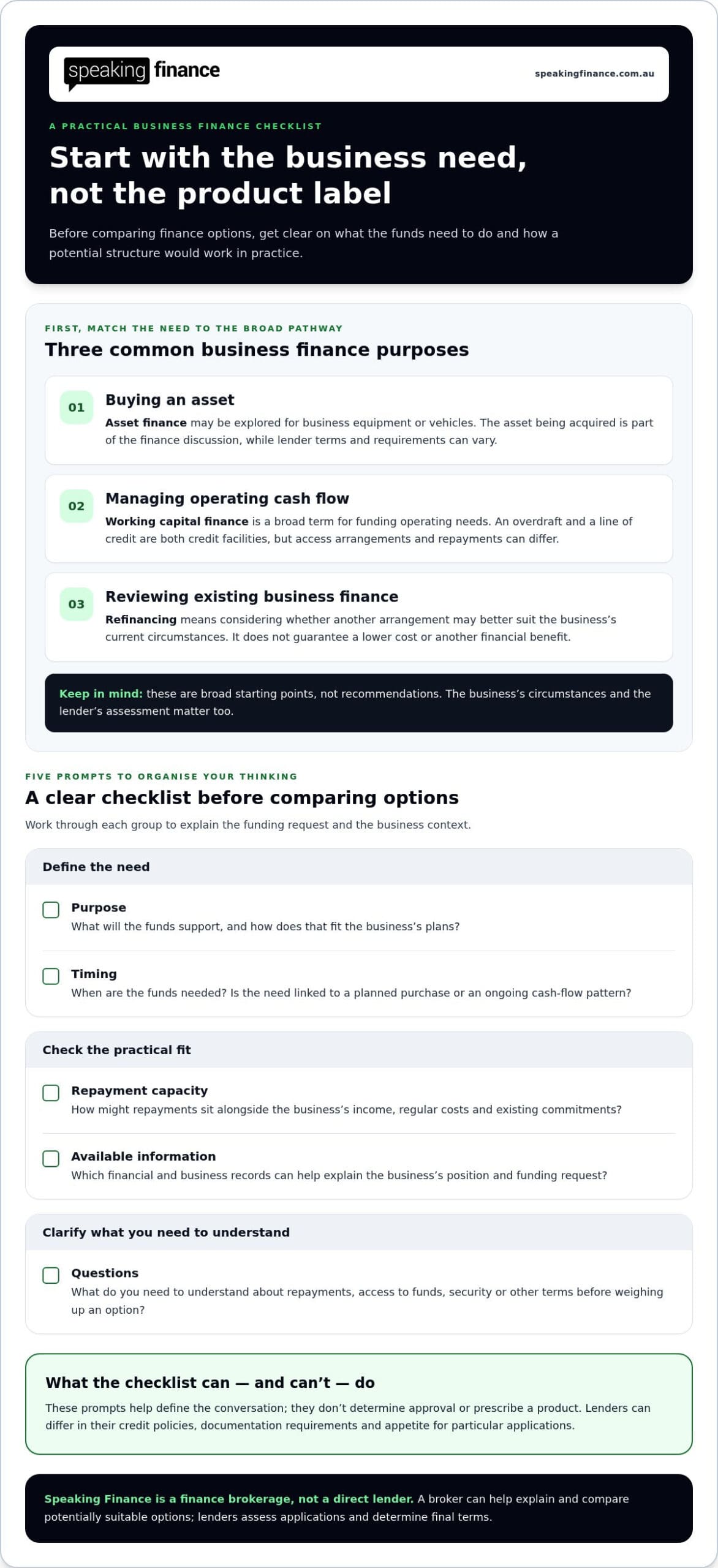
Prepare for a clearer finance conversation
Turn your funding idea into a short, practical brief. What does the business want the finance to make possible? What timing matters? Which existing commitments and cash-flow patterns should be part of the discussion? You don’t need to have every answer ready. A clear starting point can make the questions easier to work through.
Understanding business loan options in relation to your circumstances can help you identify what to explore, what information may be relevant and which terms you’ll want clarified. Take time to understand the proposed structure, costs and responsibilities before deciding how to proceed. If you need accounting, tax or legal guidance, speak with a suitably qualified professional.
You don’t need to settle on a product label before discussing the business purpose. Start with what you’re trying to achieve, then build your understanding from there.
Frequently Asked Questions
How much can a business borrow?
There isn’t a single borrowing limit that applies to every business. The amount a lender may consider depends on the business’s circumstances, funding purpose, financial position and the lender’s assessment. Discussing finance options in relation to your situation can help frame the conversation, but only a lender can assess an application and confirm any amount or terms.
Can a sole trader apply for business finance?
Yes, a sole trader can explore business finance. Being a sole trader doesn’t automatically rule out a finance enquiry, though each lender applies its own assessment approach. Be ready to explain what the funds would support and how the business operates. Depending on the application, a lender may ask for information about income, expenses, existing commitments or business records.
Does a finance broker lend money directly?
No. Speaking Finance is a finance brokerage, not a direct lender. It helps business clients understand possible finance pathways and arranges finance through lenders. If an application is approved, the lender provides the finance and sets the terms. Read the lender’s offer carefully and ask questions about anything you’re unsure of before proceeding.
Will a broker send my business loan application to several lenders?
Not automatically. Whether an application is presented to one or more lenders depends on the enquiry and which lenders may be relevant to the circumstances. You can ask which lender or lenders are being approached, why they’re being considered and what information will be shared. Access to a broad lender panel doesn’t mean an application is sent to every lender.
To talk through your business purpose and understand possible finance pathways, See How We Can Help →

Article by
Steven Emms
Steven Emms is the Director of Speaking Finance, an Australian finance brokerage based in Melbourne, Victoria.
Steven and his team help consumers, sole traders and businesses navigate vehicle finance, equipment finance, business lending, working capital and personal finance. His approach is simple: explain finance in plain English, cut through unnecessary jargon and help clients make informed decisions.
At Speaking Finance, the philosophy is simple: **We make finance black and white.**
Outside of finance, Steven is a long-suffering Essendon supporter, which has given him plenty of practice managing expectations and dealing with disappointment.
Disclaimer
The information in this article is general in nature and is provided for educational purposes only. It does not take into account your personal circumstances, financial situation, needs or objectives and should not be relied upon as personalised financial or credit advice.
Speaking Finance is a finance brokerage, not a direct lender. Finance products, interest rates, fees, terms and eligibility criteria vary between lenders and are subject to individual assessment, applicable lending policies and approval. No finance approval or particular outcome is guaranteed.
Information is believed to be accurate at the time of publication but may change. Before making financial decisions, consider your circumstances and seek appropriate independent professional advice where necessary.